
Cold hardy ornamental banana plants for temperate gardens
(Musa - Banana tree, Musella - Chinese Yellow Banana Plant, and Ensete - Red Banana Plant)
Many Americans assume that there is just a single banana plant but in fact there are several species of banana trees and hundreds of cultivars. The term "Banana" is used to describe any member of the family Musaceae which includes both edible plants and sun-loving ornamental summer perennials for the garden or containers. The banana plant family contains 3 genera; Musa (the common banana tree), Musella (the dwarf banana plant), and Ensete (a mid-sized ornamental banana plant). Edible fruit comes from hybrids of the genus Musa.
Read More About Banana Plants
All three genera of banana plants are ornamental and produce large, tropical looking plants. Most banana plants are not hardy enough for temperate gardens but luckily, a few like Musa basjoo migrated to cold mountain tops in their native countries and evolved some degree of cold tolerance. We search out these cold hardy banana trees, propagate them and make them available through our on-line plant catalog. A Banana tree excels as a tropical looking garden perennial with its large, tropical, sometimes colorful leaves along with large, exotic flowers and, occasional fruit. You can read a much more detailed account of ornamental bananas in our banana plants essay.
When you are ready to buy tropical looking banana plants for your garden, check out our online list of cold hardy, ornamental banana trees for sale below.
Since 1988, Plant Delights Nursery has been the choice of serious gardeners and plant collectors looking for the best and rarest perennial plants. We are pleased to have received the Perennial Plant Association Retail Award in 2011, the American Horticulture Society Commercial Award in 2002, and to have been selected as one of the Best Mail Order Plant Nurseries - Garden Design Magazine 2010. Welcome to our family of plant lovers!
We have long been amazed by Ensete maurelii, a superb ornamental banana from the high mountains of East Africa. Growing to only 10' tall in temperate climates (20' tall in tropical areas), Ensete maurelii makes a superb ornamental for the summer border. Each leaf can reach gigantic proportions of 10' long. The most ornamental characteristic is that the foliage is flushed with burgundy, especially concentrated as the new growth emerges. The higher the light levels, the stronger the coloration. We have also seen Ensete maurelii used in large summer containers with great effect. All ensetes are non-offsetting monocarpic plants...they die after they flower. If you've ever seen the magnificent flower, it's well worth the loss. Pot Size: 2 qt. (1.892 L)
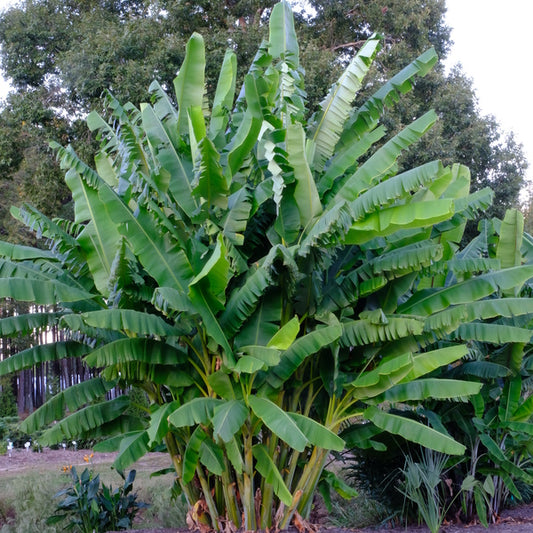
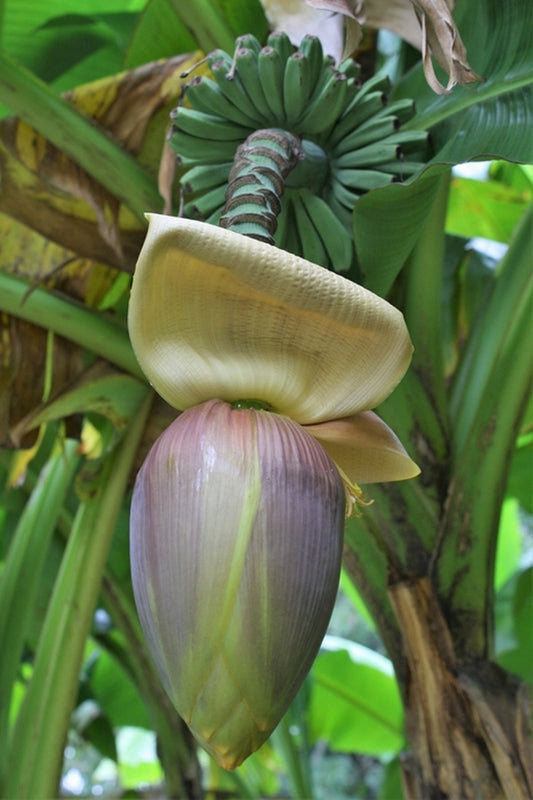
Available 6-27-2013 Recent research has shown that Musa basjoo, the world's hardiest banana species, is actually from Sichuan, China and not Japan. This 16-20' tall running species makes a thick, green stem that sports 6' long, narrow, green leaves arching from the top of the trunk. The flower of Musa basjoo emerges from near the top of the stem like a yellow-orange torpedo. After the flowers open, you will be blessed with clusters of small, yellow, 2" long bananas. Forget eating this one...just enjoy the tropical look and tease your neighbors. We recommend a good mulch in colder regions until your Musa basjoo clump becomes well-established. Pot Size: 3 qt. (2.83 L)
This banana was recently discovered around 5,000' elevation in the plant-rich eastern Himalayan region of Darjeeling, India. Musa 'Helen's Hybrid' is thought to be a hybrid of Musa sikkimensis and the edible Musa 'Chini-Champa'. The green leaves are occasionally marked with an upper red midrib, but you can consistently count on bright red leaf backs on the new foliage. The fruit is sweet, but seedy...sort of like the "treats" in a cheap Bangkok hotel. So far, these have survived 9 degrees F in our trials. Pot Size: 2 qt. (1.892 L)
Musa itinerans 'Burmese Blue' is interestingly a form of Musa itinerans from nearby northern Thailand where it makes 18' tall trunks and spreads underground via long stolons. Because of the elevation at which Musa 'Burmese Blue' occurs, there is a good possibility of some winter hardiness. Reportedly, when Musa 'Burmese Blue' matures, it produces nice purple bananas...we'll see. These are for experimental gardeners who like to try something new.
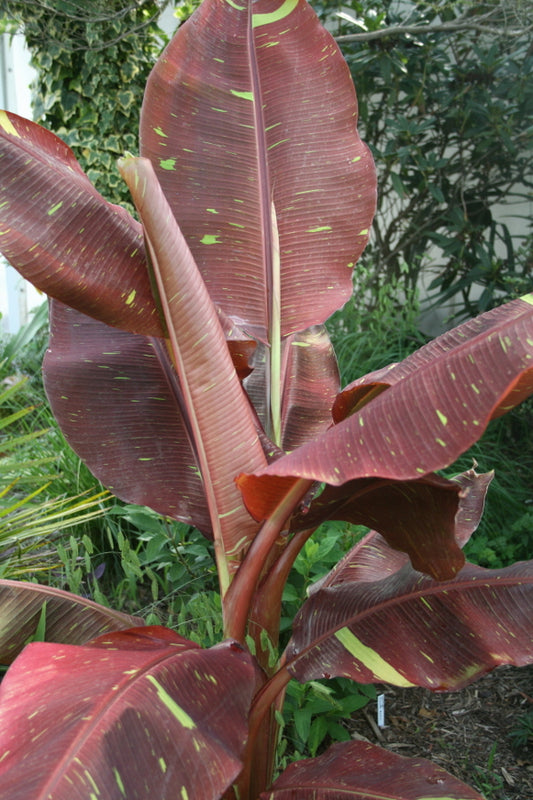
I first saw this raving beauty when visiting Thailand in 2005. At great expense (I'm still driving my old vehicle), I procured one to bring home, we named it 'Siam Ruby', and we are thrilled to now be able to share it with folks here in the states. Our research indicated it originated in Papua New Guinea, where bananas have been cultivated for 10,000 years, as a sport of Musa 'Tapo'. We have never seen it taller than 8', so that's our guess for height. The leaves are a stunning, dark ruby red with tiny green flecks...the more sun, the more intense the color. This is one banana that loves intense heat and humidity...dazzling, stunning...can you tell I've lost my adjectiveness over this plant? Pot Size: 2 qt. (1.892 L)
(syn: Musa hookeri) We are excited to again offer the little-known hardy ornamental banana, Musa sikkimensis, hailing from high montane forests of the northeast Himalayas. Reportedly, the trunks can reach 14' in height with a diameter of 18" or, in other words, about the size of an NFL offensive lineman's neck. The leaf backs emerge a dazzling cinnamon-red. To say Musa sikkimensis bananas are edible is about like saying that Himalayan bathrooms are comfortable...both have an aroma, but that's about it. Pot Size: 2 qt. (1.892 L)
We are thrilled to offer this splendid form of the winter-hardy Musa sikkimensis, hailing from the high montane forests of the northeast Himalayas. Musa 'Bengal Tiger' (a selection from the less colorful Musa 'Red Tiger' strain) forms a 14' tall specimen with dark green leaves, heavily splotched red on the front and emerging solid red on the back. Each seedling has been selected for good red color, since the amount of red can vary dramatically from plant to plant. To say the fruit from Musa sikkimensis is edible is like saying that most remote Himalayan bathrooms are comfortable...both have an aroma, but that's about it. Pot Size: 2 qt. (1.892 L)
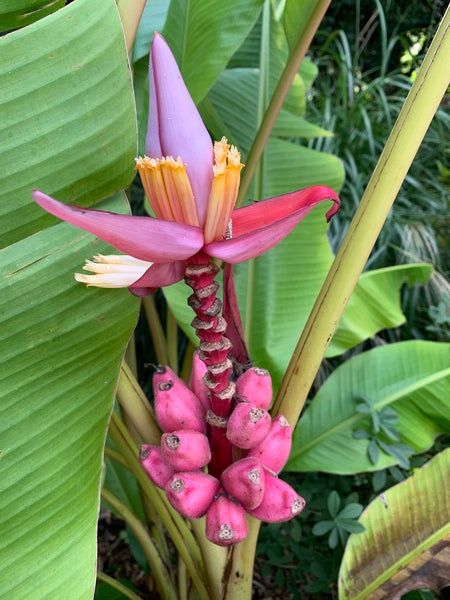
There's something mystical about a pink velvet banana that makes you want to start belting out Elvis tunes...hmmm. Musa velutina was our first introduction to hardy bananas and is still a favorite in our summer garden. Rarely exceeding 6' tall, Musa velutina produces copious flower stalks near the top of the trunk, starting in late summer. Each stalk is soon home to attractive clusters of small, pink, velvety bananas, which peel themselves when ripe. Don't plan on a snack from these seed-filled bananas unless you are exceedingly hungry or exceedingly drunk. Once established, they seem to be quite winter-hardy. Until well-established, a cage of shredded leaves around the trunk in the winter months should do the trick. Pot Size: 2 qt. (1.892 L)
(aka: Musa itinerans var. xishuangbannaensis) Musa xishuangbannaensis is a newly discovered species of cold-hardy giant banana from Yunnan, China. Musa 'Mekong Giant' is a seedling selection made by our friend, Brian Williams, of Louisville, Kentucky, for its bright reddish-purple trunk in addition to its outstanding winter hardiness in Louisville's Zone 6 climate for over nine years. Imagine a Musa basjoo on steroids and you get the idea, although Musa 'Mekong Giant' spreads from long rhizomes. In temperate climates, expect a 15' tall specimen, although it can reportedly reach 40' in climates with milder winters. I predict lots of folks will be goin' bananas over this one! Pot Size: 2 qt. (1.892 L)
This magnificent ornamental banana is more of a shrub than the typical taller banana. The stiff, thick, leathery, grey-green, banana-like foliage is borne atop a stalk that can eventually reach 6' in height. Instead of being prized for its fruit, Musella lasiocarpa is grown more for its flowers. Each specimen is home to large, bizarrely beautiful, yellow flowers that look like giant golden artichokes...I'm not making this up! For us, Musella lasiocarpa has sailed through over a decade of winters...and without any mulch. I'm starting to believe those rumors of incredible winter hardiness. Pot Size: 3 qt. (2.83 L)