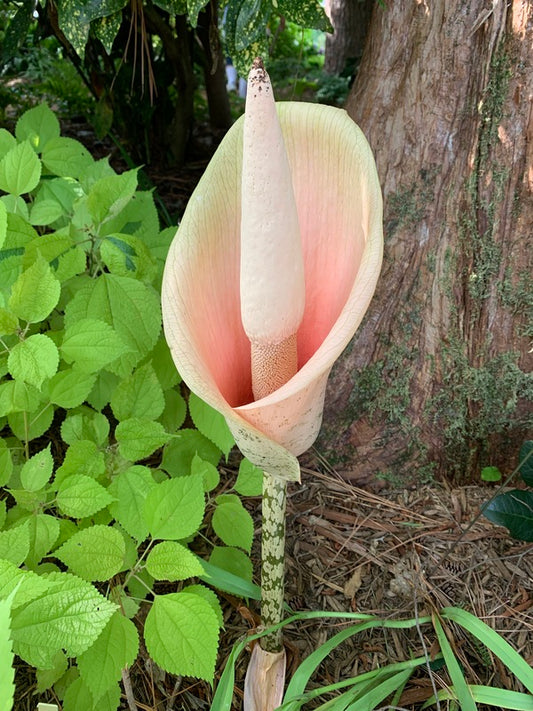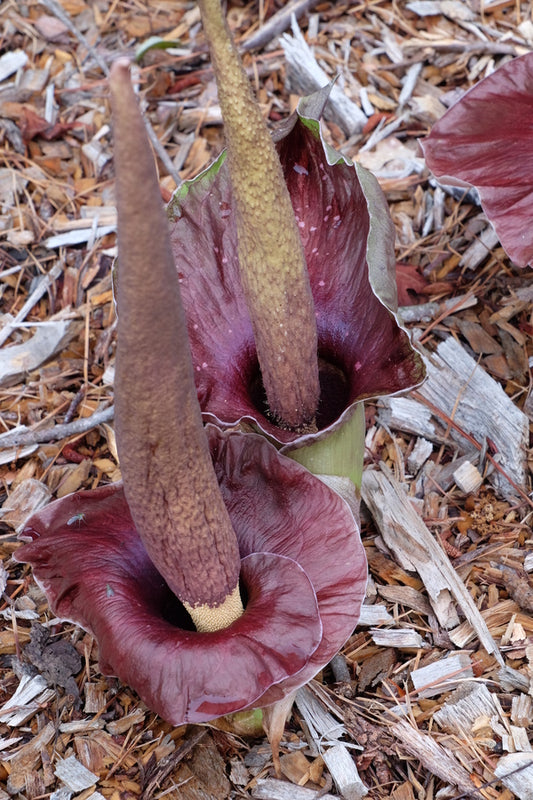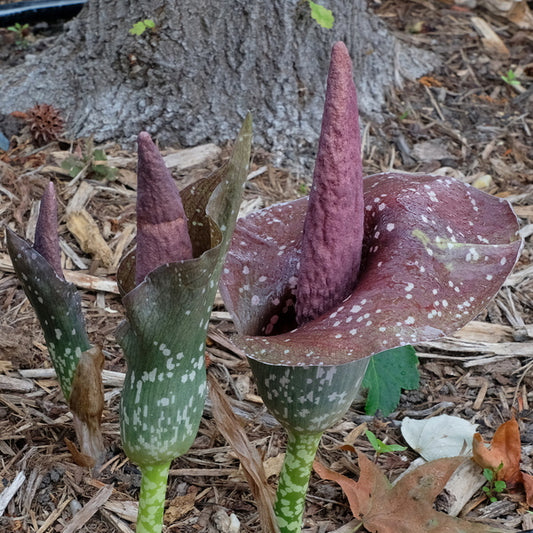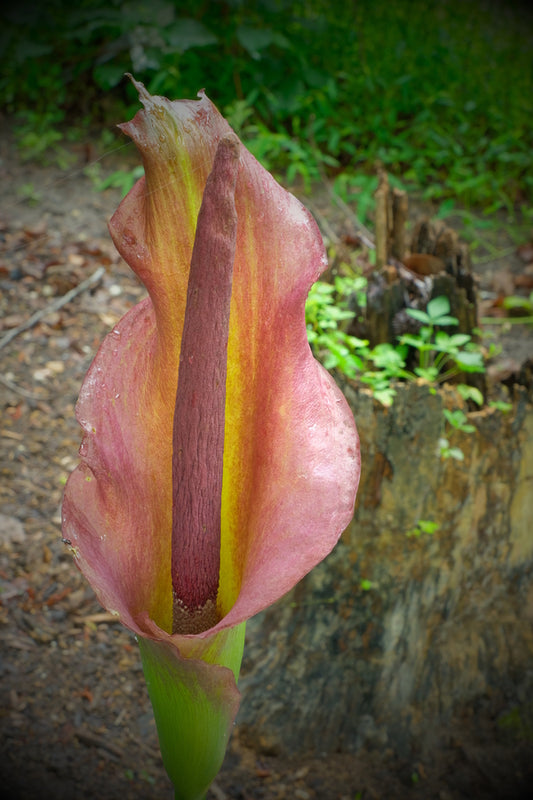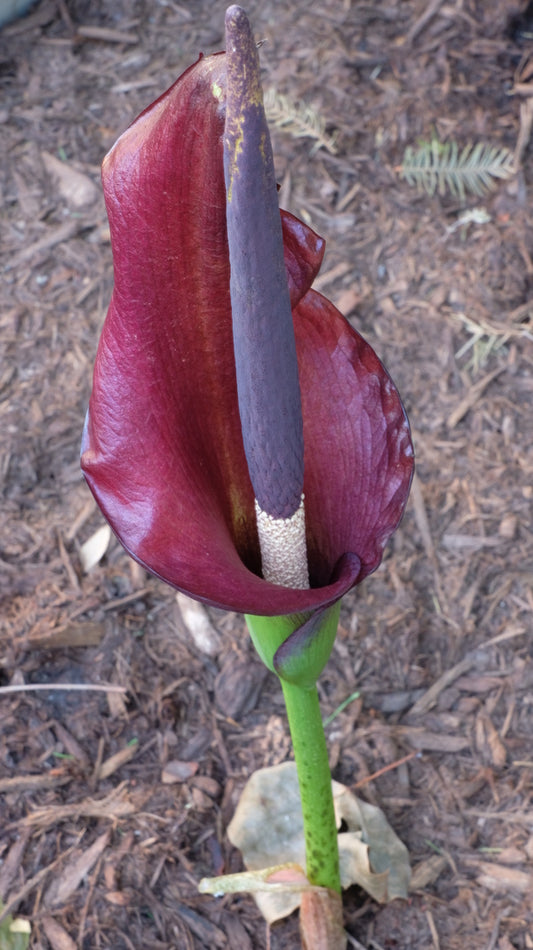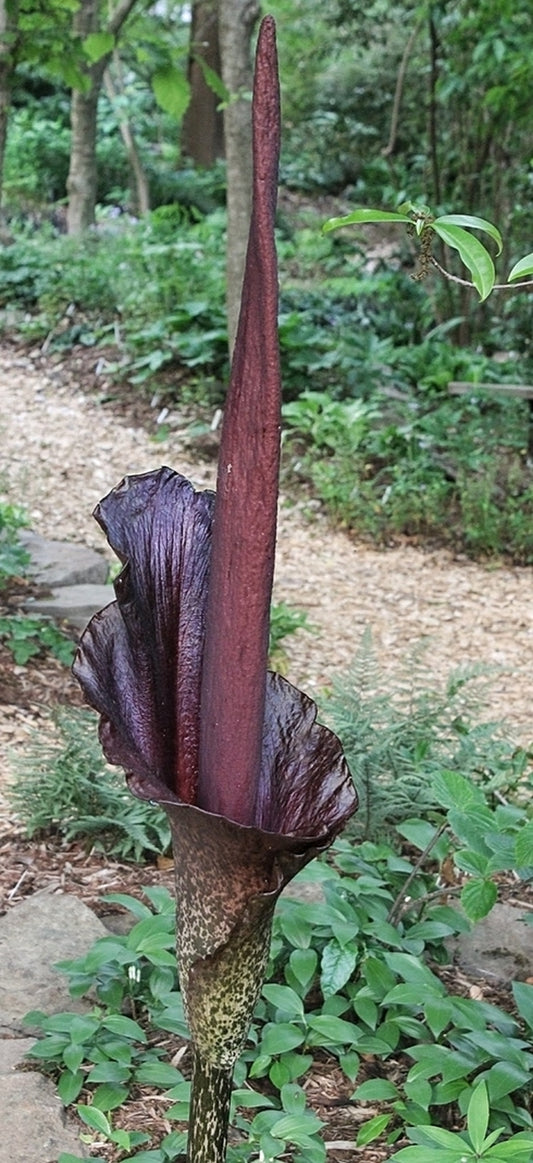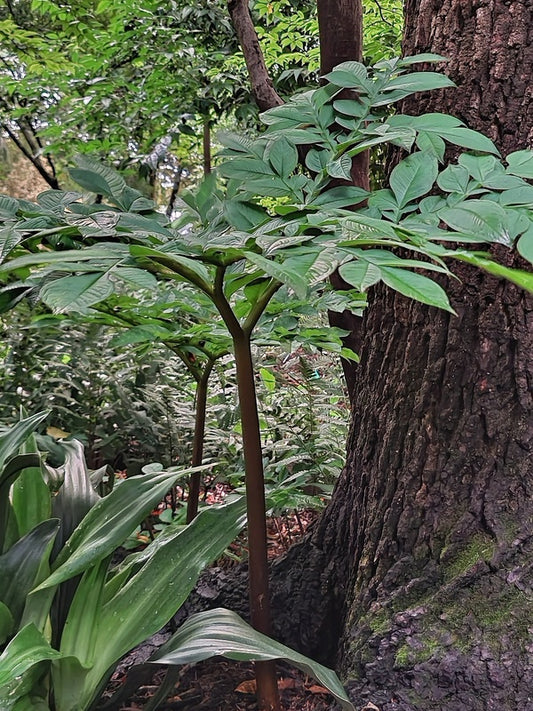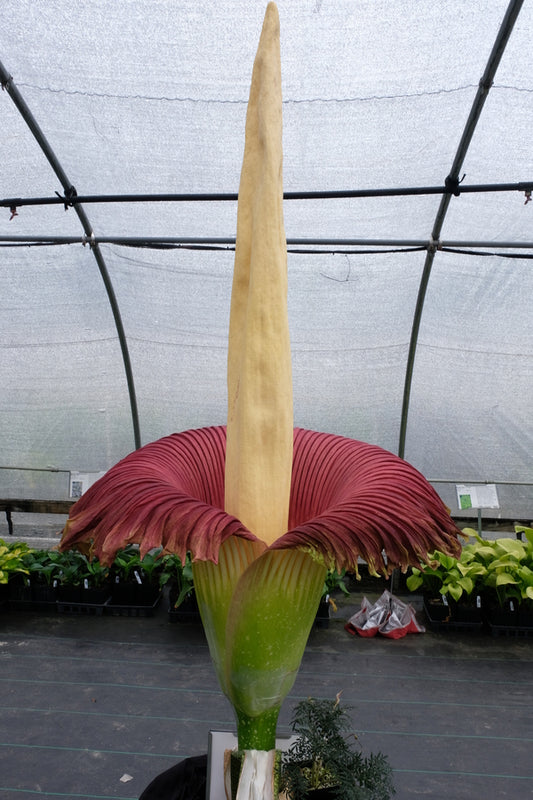
Amorphophallus are exotic plants in the aroid family, which includes popular woodland garden perennials such as arisaema (jack-in-the-pulpit) and dracunculus. The name amorphophallus comes from the Latin amorpho (deformed) and phallus (a male anatomical member)...in other words, the flower resembles a deformed male sex organ...I'm not making this up. While several amorphophallus have proven to be winter-hardy, flowering shade plants for us, others are grown as potted curiosities.
Read More
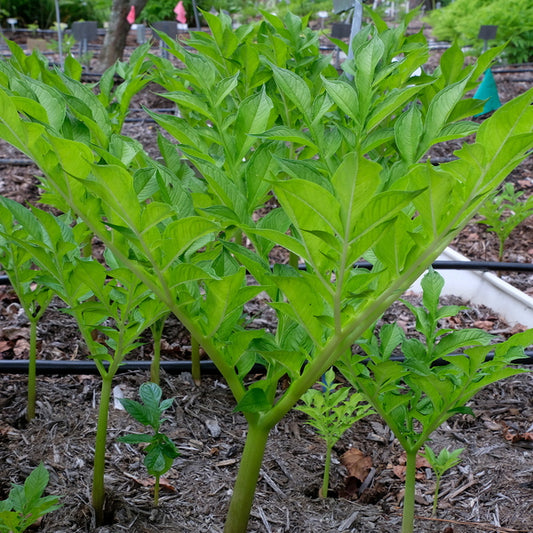
Each amorphophallus tuber produces one inflorescence, some of which can get quite large...i.e., Amorphophallus titanum. The flowers are renowned for their odor, which attracts flies for shady sexual purposes. The odor, which in some species is quite noticeable for about a half day, is the basis for great storytelling. After flowering, each amorphophallus tuber will rest for at least a month (or occasionally an entire year) before producing a single, deer-resistant leaf.
Larger tubers will keep their foliage longer into the season than smaller ones, due to the large amount of energy required to support this oversized shade garden plant. In the garden, we recommend planting the amorphophallus tuber so that its top is 4-6" below the soil surface...slightly deeper in colder climates. When amorphophallus tubers get large, they tend to form a cup that holds water...bad in areas with cold winter rains. To prevent rot we recommend you dig your amorphophallus after it has gone dormant in late summer and turn it sideways so that water does not collect in the winter. Old tubers die and regenerate each season, so keep the foliage healthy and growing.
In places where they are not hardy perennials, amorphophallus can be brought in for the winter. Some amorphophallus tubers can be stored dry while others must remain potted (see individual descriptions). While the flowers may be produced in early spring, amorphophallus foliage rarely sprouts before mid- to late June, so don't panic when you don't see any signs of life in early spring.
Plant Delights Nursery has one of the best collections of Amorphophallus for sale in the United States. When you are ready to buy an amorphophallus for your garden or container, we hope you will check out our list of amorphophallus for sale below.
Since 1988, Plant Delights Nursery has been the choice of serious gardeners and plant collectors looking for the best and rarest perennial plants. We are pleased to have received the Perennial Plant Association Retail Award in 2011, the American Horticulture Society Commercial Award in 2002, and to have been selected as one of the Best Mail Order Plant Sources - Garden Design Magazine 2010. Welcome to our family of plant lovers!
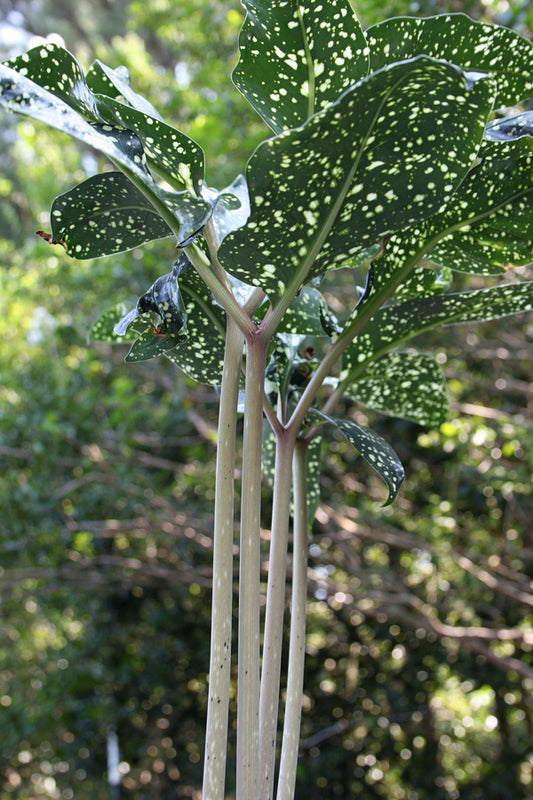
(aka: Amorphophallus asterostigmatus AGA-2004D3) It was fascinating to see this rare species in situ (a fancy botanic word meaning where it grows naturally) in the Lop Buri region of Thailand. The plants are usually wedged tightly between large boulders where drainage is good and soil is at a minimum. The offsetting rhizomes produce 3' tall, gorgeous tan/pink stems, usually highlighted with black spots. The white spathe and spadix sit atop a 1' tall stalk. We think this makes a superb manageable-sized potted specimen where it is not winter hardy.
This offering is a fast-offsetting clone that has more spots than is typical with the seedlings we have grown. Pot Size: 3.5" (24 fl. oz/709.77 ml)
This stunningly beautiful Amorphophallus atroviridis is found on rocky cliffs in north central Thailand around the town of Sara Buri. The 18" tall, reddish brown (often speckled) stalks are topped with wide-lobed, black leaves, surrounded by a bright red border. The summer-borne inflorescence sits atop a short flowering stalk and resembles a small pink cup that holds a well-sized spare part for a urology transplant. Thanks to amorphophallus guru, Alan Galloway, for making this offer possible. Pot Size: 3.5" (24 fl. oz/709.77 ml)
Amorphophallus atroviridis 'Pewterware' is a Plant Delights selection of the north central Thailand species that typically has black foliage. The foliage on Amorphophallus 'Pewterware' is, as you can no doubt surmise, pewter, surrounded by a narrow red edge. The 1' tall stalks are speckled reddish brown. The summer-borne inflorescence sits atop a short flowering stalk and resembles a small pink cup that holds a well-sized spare part for a urology transplant. This is a very limited offering. Pot Size: 3.5" (24 fl. oz/709.77 ml)
(aka: Amorphophallus atroviridis PDN009) Amorphophallus atroviridis 'Thai Hot Spot' is our collection of Amorphophallus atroviridis from a Buddhist monastery (with permission) in Thailand's Lop Buri Province in 2002. The 18" tall stalks of this clone were a particularly attractive cinnamon with large peach-colored spots. The leaves are typical near black with a faint red edge. This is our first release in 2012. Pot Size: 3.5" (24 fl. oz/709.77 ml)
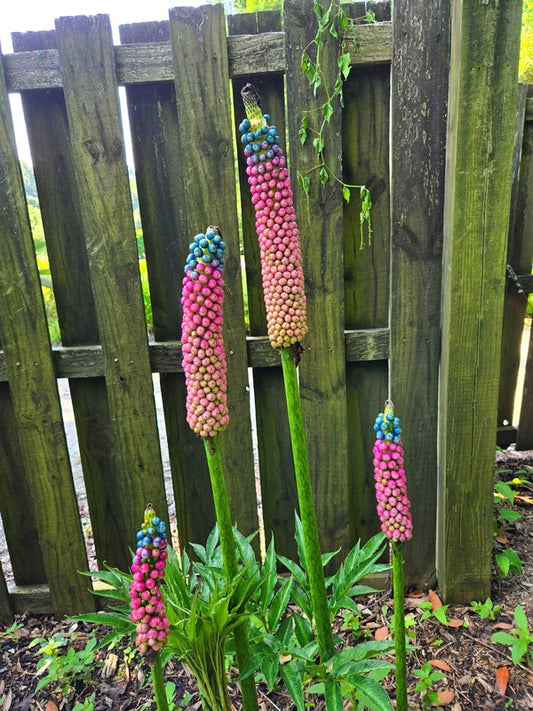
Amorphophallus crispafolius is a soon to be published (2012), species discovered by Alan Galloway on an expedition in Khammouane Province, Laos. Amorphophallus crispafolius is a small growing species that emerges from a long finger-like tuber. The 10" tall stalks are topped with a green amorphophallus-like leaf with very serrate (crispy) edges. The inflorescences are like white snow-cones revealing a well-endowed fleshy pink spadix with a white head...send yours to school with your kids for show and tell. If your Amorphophallus crispafolius is able to successfully mate, you'll be rewarded with a stalk of lovely cobalt blue berries. Pot Size: 3.5" (24 fl. oz/709.77 ml)
Amorphophallus declinatus is a little-known species, discovered by plant explorer Mary Sizemore in Palawan, Philippines. In form, Amorphophallus declinatus resembles Amorphophallus konjac. The 4' tall rough feeling stalks are dark, but highlighted with large silvery blotches. The inflorescences are quite spectacular with a large pitcher (spathe) that is mottled grey, while the top of the spathe is a nice purple-red, complementing the long purple spadix. The front of the spathe drapes (i.e., declinatus = declines) around the spadix in a less than effective attempt at modesty. Pot Size: 3.5" (24 fl. oz/709.77 ml)
(aka: Amorphophallus odoratus) Similar to Amorphophallus yunnanensis, Amorphophallus dunnii boasts a peculiar flower stalk that reaches 2' tall, topped with an 8-10" ice cream cone-like flower. The vase (spathe) looks like a green and white speckled cone with a "zipped-open" front...for better exposure. The creamy white, bulbous sexual appendage (spadix) sits like a...well, you know...a sexual appendage inside the spathe. According to amorphophallus guru Wilbert Hetterscheid, the flower smells of fresh carrots, but then who could trust Wilbert's nose after smelling so many amorphophallus? The 2' tall speckled stalk is topped in summer with typical amorphophallus foliage. This fast-offsetting species is an easy one for beginners. Pot Size: 3.5" (24 fl. oz/709.77 ml)
From Taiwan comes this amazingly hardy dwarf voodoo lily. In flower, expect a spathe that resembles one of those '60s vinyl lawn chairs with ruffled edges, while emerging from the center is a spadix that...well, even Bob Dole could be proud of. The spadix emerges looking like a giant purple carrot that later develops a bad case of acne before it goes limp. After flowering, and if it had really good sex, you'll soon enjoy seeing the 1' tall spike of dark blue berries. Once the tuber has rested from the flowering episode, expect a 2' tall, speckled green petiole with white blotches to arise, topped by a giant divided leaf. This is one of the most prolific offsetting species we grow, so there'll be plenty to share with your equally demented neighbors. Pot Size: 3.5" (24 fl. oz/709.77 ml)
Amorphophallus impressus hails from Malawi, Africa where it forms stoloniferous patches of 30" tall stalks. The inflorescences resemble Amorphophallus henryi with the classic phallic spadix emerging from what appears to be a red toilet seat. This particular clone has a darker brown stalk than what we find is typical. Amorphophallus impressus must be kept dry in dormant months. Pot Size: 3.5" (24 fl. oz/709.77 ml)
This voodoo lily hails from the Cuc Phuong region of North Vietnam, just south of Hanoi. The glossy green foliage is held atop 30" light green petioles. The inflorescence, which sits atop a 1' tall stalk, is composed of a thick creamy-white spadix with a unique spiral staircase-like pollen column below the tip. All of this is held in a small, green, cup-like spathe...truly a mouth-see-tongue moment. Pot Size: 3.5" (24 fl. oz/709.77 ml)
(formerly Amorphophallus rivieri v. konjac, Hydrosme rivieri) This unusual tuberous plant has one giant divided leaf on top of a 5-6' tall, green and purple mottled, fleshy stalk (petiole). When old enough, the tuber produces a fascinating 6' flower (early May, before the leaf emerges), resembling a giant vase made from the purple vinyl used for cheap '70s car seats. The vase (spathe) is home to a 3' purple spadix that sits atop a 2' speckled petiole...gather your neighbors for the flowering ritual. After flowering, the plant may rest for a couple of months before the leaf emerges in late June. The mother tuber will form offsets, eventually making a giant clump...STRANGE! We ship quarter-sized or larger tubers that are 3-4 years from flowering size. Pot Size: 3.5" (24 fl. oz/709.77 ml)
We are pleased to offer this 2004 Alan Galloway discovery which was named as a new species in 2007. Amorphophallus myosuroides was discovered growing on vertical, shaded rock ledges in the Khammouane Province of Laos. The tiny but rapidly offsetting tuber produces a solitary, light green, radial leaf atop each 8" tall stalk. Within a few weeks of the leaf appearing, an 8" tall white mousetail-like (the genus Myosurus means "mousetail") inflorescence appears on a separate 8" tall stalk. Amorphophallus myosuroides re-flowers up to 3 times during the summer. We owe Alan a round of applause for finding this gem. Pot Size: 3.5" (24 fl. oz/709.77 ml)
(aka Amorphophallus ochroleucus AGA-831) This little-known species hails from the Gai Lai province of North Vietnam. This lovely clone, with an 18" tall olive stem highlighted by black-purple spots, is topped with a solitary palm-like leaf. Amorphophallus ochroleucus is unique among related species such as Amorphophallus krausei and Amorphophallus salmoneus in that it flowers in midsummer while the plant is in foliage. The inflorescence is composed of a short flesh-colored spathe stained in purple, cuddling a creamy white spadix...very cute as amorphophallus go. Pot Size: 3.5" (24 fl. oz/709.77 ml)
This is one of the most unique miniature species in the genus Amorphophallus...only discovered in 2004 and then named and described in 2006. The species was discovered in the Khammouane Province of Laos by Alan Galloway and Annop Ongsakul (for whom it was named). The tiny pinhead-sized tuber produces a 3" tall stem topped with a leaf which resembles a cutleaf fern. The equally tiny flower emerges alongside the mature leaves. This is an incredibly cute and very easy-to-grow plant...perfect for a windowsill. Pot Size: 3.5" (24 fl. oz/709.77 ml)
(aka: Amorphophallus pygmaeus AGA-1052F) This seedling is one we pulled out of an Alan Galloway seed collection from Thailand. Instead of the typical nearly black foliage, this one has amazing pewter foliage. So far, Amorphophallus 'Pewter Pan' has remained quite small, and we anticipate a full grown plant will reach only 6" in height...so very cute! When mature, the tuber produces a 15" flowering stalk, topped with a creamy pink spathe and an oversized white spadix. We only have a limited quantity of these, so don't delay. The tuber can be stored dry when dormant. Pot Size: 3.5" (24 fl. oz/709.77 ml)
(aka: Amorphophallus symonianus Home #2) This Mary Sizemore discovery from north central Thailand is named for the late amorphophallus enthusiast, Dr. James Symon. In 2006, we saw it growing in rock crevices around some of the Buddhist temples. It is one of the easier species to grow in containers, forming a 2' tall specimen with an olive-green speckled petiole, topped by a green leaf. The unique feature of Amorphophallus symonianus is that it forms intercalary bulbs in the fall. You'll recognize the blessed event when the leaf swells where it is attached to the petiole like an alien trying to emerge from within. The green spathe is home to an almost human-like, perfectly shaped, white spadix. This clone is vegetatively propagated. Pot Size: 3.5" (24 fl. oz/709.77 ml)
This selection of the Thailand native Amorphophallus tenuispadix was named for its dark purple petiole, flecked with small pink spots. The 15" tall stalk on this fast-offsetting species supports the small, palm-like foliage. In June/July, the inflorescences appear as small, pale pink cups holding an oversized, x-rated, fleshy appendage...great for spicing up the garden party conversation. Pot Size: 3.5" (24 fl. oz/709.77 ml)
This fun, easy-to-grow species from Yunnan, China makes a small plant to 3' tall. The single leaf is held atop a 2-3' tall, smooth, dark green stalk, beautifully mottled with lighter green to flesh-colored blotches. The flower emerges in early spring, albeit nothing like its better-endowed cousins. The 3-6" tall spadix, looking like a pink alien head with a white neck, sits atop a nicely mottled 1-2' tall petiole (stalk). To help hide the bizarre spadix from possible suitors is a green, speckled, hooded spathe. Amorphophallus yunnanensis has an undetectable scent...quite curious in a genus known for its odor. The large tuber offsets freely and these can be easily removed if it is stored dry for the winter. Pot Size: 3.5" (24 fl. oz/709.77 ml)
Amorphophallus arcuspadix is a new, soon to be published (2012), species of Amorphophallus from an Alan Galloway discovery in Bolikhamxay Province, Laos, where it was growing in shaded areas among limestone boulders. Amorphophallus arcuspadix is closely related to Amorphophallus verticillatus. The 1' tall stalks, which are topped with typical amorphophallus foliage, multiply by stoloniferous offsets to form a small colony of stalks. The stalks of white inflorescences also strongly resemble Amorphophallus verticillatus, except for the strongly arched spadix. Pot Size: 3.5" (24 fl. oz/709.77 ml)