 |
 |
|
Pulmonaria (Lungwort)
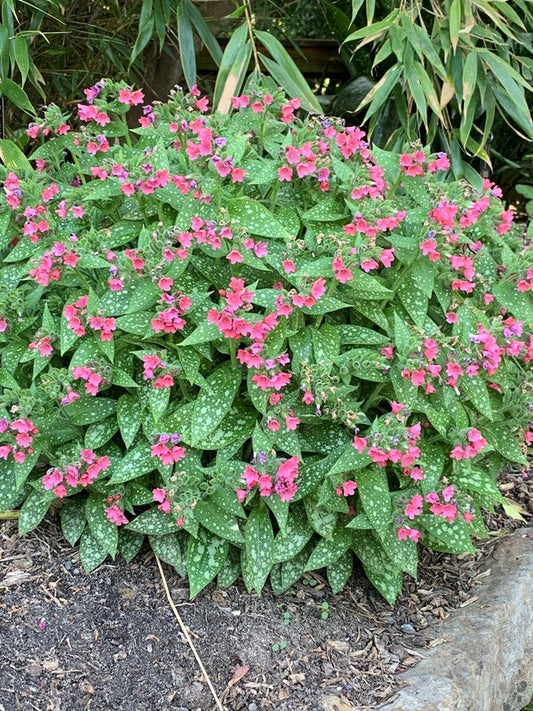
Named for the organ that most resembles the foliage, pulmonaria actually means lungwort. Despite a sickly name, these wonderful, clumping, borage relatives are indeed beauties in the shade garden. The leaves range from solid green to nearly pure silver. Pulmonarias rival hellebores to be the first flowering perennials in the late winter and early spring. Pulmonarias prefer light shade and a moist but well-drained site. Lungworts establish quickly when planted and make a superb spring show.
|
Pulmonaria 'Dark Vader' PP 12,333 (Dark Vader Lungwort)
Light Shade to Shade Zone: 4-8 12" tall Origin: Hybrid
This new Terra Nova hybrid boasts one of the greatest names in horticulture...Dark Vader (a little horticultural parody). The dark green leaves on this vigorous clumper are nicely covered with large silver speckles. In very early spring, the clumps are topped with sprays of flowers...both blue-purple and pink at the same time. Lungworts are great to blend with early bulbs such as crocus, scilla, and other similarly colored spring bloomers. Pot size: 24 fl. oz (709.77 ml) #04346
|
Pulmonaria 'Samourai' (Samourai Lungwort)
Part Sun to Light Shade Zone: 4-8 8" tall Origin: Hybrid    alternate image
I was amazed when I first saw Pulmonaria 'Samourai' in Holland in the summer of 2004. From Didier Willery of France comes this cross of Pulmonaria 'Majeste' x P. longifolia var. cevennensis that makes a superb clump of narrow, pure silver foliage unlike any pulmonaria I'd ever grown. In spring, the clumps are topped with cobalt blue flowers. After a brutally hot summer with 70+ days over 90 degrees F, the clumps still looked fabulous...thanks to the P. longifolia parentage. Pot size: 24 fl. oz (709.77 ml) #06354
|
Pulmonaria 'Trevi Fountain' PP 13,047 (Trevi Fountain Lungwort)
Part Sun to Light Shade Zone: 4-8 11" tall Origin: Hybrid
This Terra Nova introduction has been a stellar performer in our trials for heat and humidity tolerance. P. 'Trevi Fountain' boasts heavily spotted silver leaves on a 2' wide clump. In early spring, the vigorous clumps are topped with fountains of large dark cobalt-blue flowers...very attractive and great for a mass planting in the woodland garden. Pot size: 24 fl. oz (709.77 ml) #04872
|
|
Punica (Pomegranate)
Yes, they're hardy, but don't expect grocery store-sized fruit from the winter hardy selections. These shrubby natives to the Caucuses produce very attractive flowers, followed by their characteristic fruit that resembles a mutated apple. We have selected only forms which we have found to be reliably hardy to 0 degrees F. |
Punica granatum 'Eight Ball' (Eight Ball Hardy Pomegranate)
Sun Zone: 7-10 90" tall Origin: Europe, Asia
NEW!
This is the tallest of two seedlings we selected in 1986, from a batch of dwarf pomegranate seedlings. It survived our 9 degrees below zero F winter with minimal damage. This form was selected for its large size, hardiness, and giant, nearly black fruit...resembling an 8 ball...great for the edible garden...as long as you aren't concerned with taste! Pot size: 24 fl. oz (709.77 ml) #01731
|
Punica granatum 'Nochi Shibari' (Tied Tail Pomegranate)
Sun Zone: 7b-10, at least 120" tall Origin: Europe, Asia
Open House/Web-Only!
We have long prized pomegranates for their garden value, and no cultivar has drawn more questions than the Japanese cultivar 'Nochi Shibari', which means "large snotty orange tissue with a white topping"...just kidding. It actually means "bound or tied-up tail"...I'll leave it to your imagination as to why. This vigorous clone makes a 10' tall shrub with glossy green leaves. Starting in June, P. 'Nochi Shibari' is adorned with unique flowers...think orange carnation boutonnieres on both steroids and Ecstacy. The thick, waxy, orange calyx holds the double orange flowers, which are tipped in white. If you are into weird, don't let this offering pass you by. Pot size: 24 fl. oz (709.77 ml) #06659
|
Punica granatum 'State Fair' (State Fair Dwarf Pomegranate)
Sun Zone: 7-10 60" tall Origin: Europe, Asia
Open House/Web-Only!
This Plant Delights selection of pomegranate is the hardiest, best-flowering, and heaviest-fruiting selection we have seen. Throughout the summer and into the fall, P. 'State Fair' is adorned with hundreds of bright orange, tubular flowers, followed by many dwarf pomegranates...to silver dollar size...a truly wonderful conversation piece. If no one wants to have a conversation, throw a few fruits at your guests and start one! Pot size: 24 fl. oz (709.77 ml) #01730
|
|
Pycnanthemum
|
Pycnanthemum 'Eagle Rock' (Clumping Mountain Mint)
Sun Zone: 6-8, at least 36" tall Origin: USA
Open House/Web-Only!
(coll. A1VA-012) They said it didn't exist, but we've found it...a clumping mountain mint. I love pycnanthemum, but hate its habit of taking over the garden, so I was thrilled when I found this specimen near Eagle Rock, Virginia, growing in an area of degraded rock known as the shale barrens. P. 'Eagle Rock' has been fabulous in our garden, making a 3' tall x 3' wide clump of peppermint-smelling, grey-green foliage. In early July, the clumps are topped with small but attractive sprays of tiny pink flowers that the pollinating insects must find as an aphrodisiac. Good drainage is best for this and most shale barren plants. Pot size: 24 fl. oz (709.77 ml) #05297
|
Pycnanthemum tenuifolium 'Cat Springs' (Narrow Leaf Mountain Mint)
Sun Zone: 6-8, at least 36" tall Origin: USA
Open House/Web-Only!
(aka: P. tenuifolium A3T-035) We passed many colonies of narrow-leaf mountain mint as we traversed southeastern Texas in spring 2003 looking for Space Shuttle debris...just kidding. It was only when we saw this incredible clump in flower near Cat Springs that we deposited a couple of inches of rubber on the Texas highway and sent a tailgating pickup into the ditch, all while reducing the groundhog population by one. Was it worth it? Yes! This marvelous form of the clumping P. tenuifolium makes a 3' tall clump of narrow green foliage with the strong fragrance of spicy peppermint. In mid-June, the clumps are topped with large, pure white flower clusters...a dramatic improvement over the typically offered forms. Plant one near your vegetable garden to attract hoards of beneficial insects. Pot size: 24 fl. oz (709.77 ml) #05666
|
|
Pyrrosia (Tongue Fern)
Pyrrosia is a genus of mostly evergreen, slowly rhizomatus Asian epiphytic ferns that adapt quite well to container culture. They also are stellar performers in the ground in warm temperate climates if they are planted on a slope. The many foliage variations of P. lingua are highly prized as collectors items in Japan.
|
Pyrrosia lingua (Tongue Fern)
Part Sun to Shade Zone: 7b-10 12" tall Origin: China, Japan, Taiwan
Open House/Web-Only!
I know these don't look like ferns, but I'm not the taxonomist. They also aren't supposed to be hardy, but ours have been in the ground for over 10 years. The rhizome grows along the ground, and the leaves arise singly from it. The leaves have a unique, cardboard-like texture with a felty backside and eventually make a nice evergreen mass. Visitors will scratch their heads...you can scratch their backside...the ferns, of course. Pot size: 24 fl. oz (709.77 ml) #00977
|
Pyrrosia lingua 'Corymbifera' (Crested Tongue Fern)
Part Sun to Shade Zone: 7b-10 12" tall Origin: China, Japan, Taiwan
Open House/Web-Only!
This rare crested form of the tongue fern is among the most beautiful of the ferns we grow. Each dark green cardboard-textured frond, which emerges from the thin surface-growing rhizome, looks like a reindeer head after a bad experience with a four-wheel drive pickup...nice antlers, but sort of twisted out of shape. Grow this evergreen fern in a well-drained site on a slope for best performance. Pot size: 24 fl. oz (709.77 ml) #01507
|
Pyrrosia lingua 'Ogon Nishiki' (Variegated Tongue Fern)
Part Sun to Light Shade Zone: 7b-10 12" tall Origin: China, Japan, Taiwan
This Japanese selection of the evergreen tongue fern has been hardy for over 10 years in our garden. The growth habit is similar to the species, forming a dense colony to 2' wide in 5 years, thanks to a short creeping rhizome. Pyrrosia lingua cultivars hate growing flat and must be planted on a slope to thrive in cold climates. P. 'Ogon Nishiki' has thick, green, vertically-held leaves with diagonal, butterscotch-yellow banding...picture an anorexic run over by a yellow Volkswagen, and you get the picture. Each 1' long x 2" wide, upright, tongue-shaped leaf would make Gene Simmons proud. Pot size: 24 fl. oz (709.77 ml) #01370
|
|
Rabdosia
|
Rabdosia longituba (Trumpet Spurflower)
Part Sun to Light Shade Zone: 6-8 36" tall Origin: Japan
(syn: Plectranthus longitubus) I'll bet you never thought of growing rabdosia before...right? From the Japanese mountains of Honshu, Shikoku, and Kyushu comes this woodland member of the salvia family. The stems of this clumper rise throughout the summer reaching 2' tall by September, when they are topped with 1' long, airy panicles containing hundreds of pendent, purple tubes. This is as hard to describe as it is to pronounce, but finding anything that flowers in the fall woodland is difficult...simply superb! Pot size: 24 fl. oz (709.77 ml) #05413
|
Rabdosia longituba 'Tube Socks' (Tube Socks Trumpet Spurflower)
Part Sun to Light Shade Zone: 6-8 36" tall Origin: Japan
Open House/Web-Only!
This new color form of trumpet spurflower was discovered in Japan, then imported and named by plant guru Barry Yinger. Rabdosia 'Tube Socks' makes an upright, 3' tall x 2' wide clump of thin green stems adorned with green leaves. Just when you are wondering why you purchased it, the clumps explode with terminal clusters of small white flowers in mid-October. If you would like to brighten the fall woodland garden, I can't think of anything better than scattering "tube socks" throughout. Pot size: 24 fl. oz (709.77 ml) #06578
|
|
Ranunculus
|
Ranunculus ficaria ssp. ficariiformis (Lesser Celandine)
Sun to Part Sun Zone: 5-9 10" tall Origin: S. Europe
Open House/Web-Only!
For late winter and early spring flowering in the garden, it's hard to beat the lesser celandines. These buttercups first appear in February and disappear completely by the end of May. R. ficaria ssp. ficariiformis is one of the largest of the celandines, making a 10" tall x 1' wide clump. The glossy green 2" round foliage is topped in late February and March by 1" bright yellow daisies, held above the foliage. While the straight species is much too weedy to grow, we have not found this the case with this special form, shared with us by plantswoman Pam Harper over 12 years ago. Pot size: 24 fl. oz (709.77 ml) #03455
|
|
Rehmannia
|
Rehmannia elata (Beverly Bells)
Sun to Part Sun Zone: 7-10, at least 12" tall Origin: China
Open House/Web-Only!
(syn: R. angulata) Visitors have fallen in love with this easy-to-grow groundcover member of the scrophularia family. In loose, moist soils, rehmannia will spread to make a nice mat of closely spaced rosettes. From late spring through midsummer, the rosettes are topped with 2' tall stalks dripping with massive, pinkish-purple penstemon-like flowers... each with yellow specks deep in the throat. Flowering is heaviest in late spring, then sporadic in the summer...OUTSTANDING!
Rehmannia is named in honor of the Russian physician, Joseph Rehmann (1799-1831). Pot size: 24 fl. oz (709.77 ml) #00422
|
|
Rhapidophyllum
|
Rhapidophyllum hystrix (Needle Palm)
Sun to Light Shade Zone: 6-10 100" tall Origin: USA
The hardiest of palms, this slow-growing Florida native has withstood -9 degrees F here with NO damage (without protection or special siting). We expect established specimens should handle -20 degrees F. This short-trunked clump-former has typical cut-leaf green palm foliage and sharp "needles" at the base to protect the seeds...very rare! In marginal climates, plant needle palms early in the season and protect them the first couple of winters until they become well established. In colder climates, we recommend up-potting young plants and keeping them indoors until they are larger.
Pot size: 24 fl. oz (709.77 ml) #01087
|
| <Polystichum - Pteris] | [Rhexia - Rohdea> |
|