You know... these are the perennial plants you don't have to go get, they will come to you. The perennial vines we offer are the more rare and unusual plants...not the ordinary ivies and wisterias that most nurseries have. Vines let you take your perennial garden vertical, and they out-stretch even the tallest of the tall perennials. After all, its nice to look up and see beautiful flowers. Some vines straddle the line between perennial plants and woody plants...these are called lianas, and we sell these too. Many vines attract hummingbirds and other wildlife.
Since 1988, Plant Delights Nursery has been the choice of serious gardeners and plant collectors looking for the best and rarest perennial plants. We are pleased to have received the Perennial Plant Association Retail Award in 2011, the American Horticulture Society Commercial Award in 2002, and to have been selected as one of the Best Mail Order Plant Sources - Garden Design Magazine 2010. Welcome to our family of plant lovers!
Aristolochia debilis is a fascinating Dutchman's pipe that hails from low mountain thickets in southern China and central to southern Japan. The deciduous wiry-stemmed vine can grow to at least 15' long, but will need something to scramble on. During the growing season, the stems are clothed with heart-shaped green leaves and adorned most of the summer with a parade of small, purple, trumpet-like flowers. The fragrant flowers attract for both butterflies and curious visitors. Not only is Aristolochia debilis great in the garden, it has a secret life as an herbal medicine called Ma Dou Ling. Aristolochia debilis has been used as an energy supplement, diuretic, anti-bacterial and antifungal agent, anti-cancer agent, antiseptic, asthma treatment, snakebite cure, and used to treat hypertension, gastric disorders, hepatitis, pneumonia, and cirrhosis of the liver...I'll drink to that! Pot Size: 3.5" (24 fl. oz/709.77 ml)
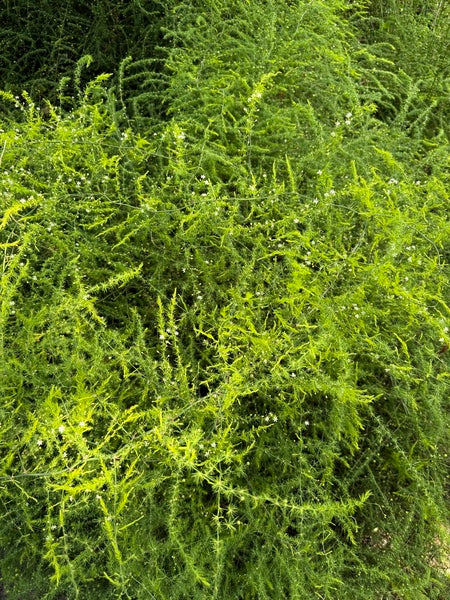
Our form of Asparagus cochinchinensis comes from Korea's Chuwang Mountain where it grows on very dry rocky acidic (pH 4.3) cliffs. The 7' long twining deciduous stalks are clothed with soft, fleshy, dark green foliage and adorned with tiny white flowers in mid-May (NC). We have found Asparagus cochinchinensis to be a wonderful textural element in the garden, best when planted where, like an inebriated partygoer, it can lean on a sturdy friend. In fall, the foliage turns a fabulous bright golden yellow. The tubers of Asparagus cochinchinensis have been used in Chinese medicine for lung and kidney cleansing, and to treat chest pain, cough, bloody phlegm and dry stools...I'm not making this up. Pot Size: 3.5" (24 fl. oz/709.77 ml)
We are thrilled to offer our winter-hardy selection of the popular houseplant, Asparagus setaceus. This form hails from near Cathcart in South Africa's Eastern Cape at 4,773' elevation, where it grows in dry rocky fields. For us, it has made a wonderful vigorous specimen against a board-on-board fence. Asparagus setaceus is composed of 8' long twining stems, adorned with soft, but bristly dark green foliage and tiny white flowers in spring. In fall, the deciduous plants are covered with tiny red fruit. So far, this has been through 7 degrees F with no adverse affects. Pot Size: 3.5" (24 fl. oz/709.77 ml)
Imagine an asparagus that behaves like a twining vine to 15' tall, has glossy green foliage covered in fragrant white flowers in late spring, and is smothered with 1/2" bright red ornamental berries in late summer. Did I mention it's cold hardy to Zone 3? Would you believe it? Well, it's true, and we are pleased to be able to share one of the most unique plants we have encountered. The original seed came from the old DeGiorgio Seed Company via the late Harlan Hamernik, who also adored this perennial in his Nebraska garden. The foliage stays green into the mid-20s F, serving as a perfect foil for the red berries. Any sturdy trellis, old junked pickup, or stationary highway worker is perfect for support...stand back and watch it grow. Fruiting should take about 3 years from potted plants...very cool! Pot Size: 3.5" (24 fl. oz/709.77 ml)
(syn: Ampelaster carolinianus) What will they think of next...a native (NC south to Florida) woody aster that climbs! We figure the North American native Aster carolinianus watched too many old kudzu movies. Yes, it grows, it climbs, it mingles, it blooms...it closely resembles a clematis in habit with fragrant lavender-pink flowers from late September into November (NC). Give Aster carolinianus a trellis, deer fence (which it really loves) or let it socialize in the border...it's actually well-behaved! Pot Size: 3.5" (24 fl. oz/709.77 ml)
Bauhinia yunnanensis hails from up to 6,000' elevation in the Chinese provinces of Sichuan, Yunnan, and Guizhou. The deciduous semi-vining Bauhinia yunnanensis emerges in late spring, producing long willowy branches to 15'-20' long. It's very possible that this will get much larger in warmer climates, so allow plenty of room. Each branch produces short tendrils designed for climbing, so a trellis or nearby sturdy woody plant would make a great display background. Starting in late August and continuing until frost, the branches are adorned with 1.5" wide, pale pink, orchid-like flowers, each highlighted by a purple central streak. We have grown this in the garden since 2004 and found it to be one of only two bauhinia species winter hardy to single digit F temperatures. We originally offered this as Bauhinia bohniana. Pot Size: 3.5" (24 fl. oz/709.77 ml)
(syn: Cissus incisa) This unique and wonderful cold hardy grape ivy is similar to the type you kill indoors in hanging baskets. Native to the US, from Kansas south into Mexico and Florida, this non-invasive vine grows naturally in habitats as diverse as dry rocky ledges as well as salt marshes...we recommend fences, gazebos, and ugly buildings. Cissus trifoliata is composed of purple stems and adorned with thick, rubbery, artificial-feeling, trifoliate foliage. Cissus trifoliata attaches to objects (usually not pets) by means of miniature suction cups. In summer, the green foliage develops a red tint to the leaf edges and in late September the 15' long vine is adorned by clusters of small, black, grape-like fruits...truly an amazing and underused plant. Thanks to plantsman Jim Waddick for turning us on to this gem nearly a decade ago! Pot Size: 3.5" (24 fl. oz/709.77 ml)
If you enjoy winter gardening, you must have the fantastic winter-flowering clematis. This Mediterranean native makes a 20' tall, well-behaved vine of glossy evergreen foliage, topped, starting in October, with 1" bell-shaped flowers of cream with dark speckles. The delightful seed heads remain on the plant for long periods after flowering. In midsummer the vine goes dormant but reemerges again in early fall. Clematis cirrhosa has proven much hardier than many references indicate, taking 0 degrees F with no problem. Although it is native in scrubby woodlands, we have found a sunny western exposure works best. Pot Size: 3.5" (24 fl. oz/709.77 ml)
(aka: Clematis 'Roguchi') Virtually anyone who has grown Clematis 'Rooguchi' agrees this hybrid, from breeder Kazushige Ozawa-sani of Japan, is one of the finest bell-shaped clematis ever introduced. Starting in early May and continuing through September, this free-flowering Clematis integrifolia x durandii hybrid is covered with large 2" cobalt blue bells...a hummingbird treat. Clematis 'Rooguchi' has an amazing range, growing equally as well in Minnesota as it does in Houston, Texas. Don't worry about pruning, since it is a perennial and will die to the ground each season. For us, Clematis 'Rooguchi' makes a 6' tall clambering vine...perfect for weaving through shrubs like a motorbike in a traffic jam. Pot Size: 3.5" (24 fl. oz/709.77 ml)
This Allan Armitage selection (cutting propagated) of the rare, climbing, yellow-flowered bleeding heart was made for its incredibly floriferous nature. Our plant is a virtual flowering machine, producing thousands of yellow, heart-shaped flowers from April through November. The fast-growing, corydalis-like, grey-green foliage climbs loosely up a trellis, fence, or sleeping neighbor...but unlike neighbors, it's never invasive. Dicentra 'Athens Yellow' ranks high on the "can't live without it" list! Even in northern climates, Dicentra scandens makes a superb deer-resistant tender perennial attractive to hummingbirds. Pot Size: 3.5" (24 fl. oz/709.77 ml)
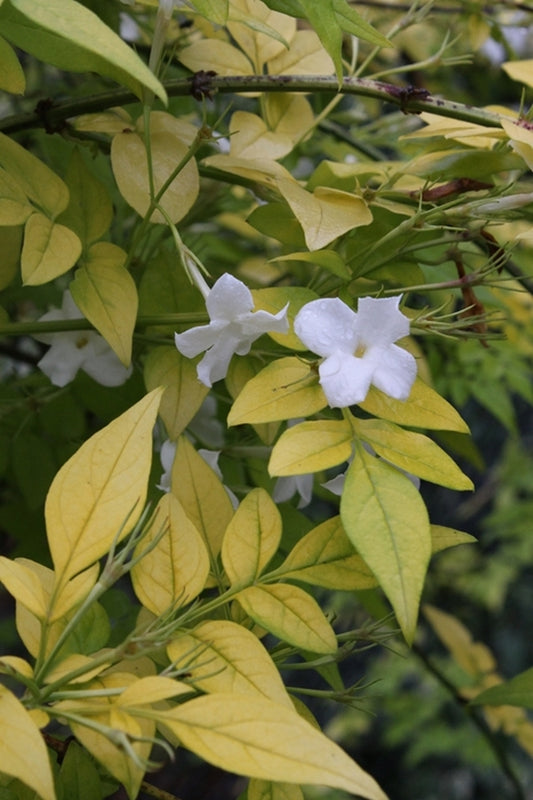
This superb form of the Chinese scrambler, Jasminum officinale, comes from Fromefield Nursery in the UK. Unlike the species that has green leaves, this seedling boasts brilliant gold foliage that holds beautifully even in our hot, humid summers. The stems are also home to deliciously fragrant flowers throughout the summer. As a gesture of forced integration, we encourage Jasminum 'Frojas' to scramble through other colored foliage plants, such as purple loropetalum and smoke tree. Each branch of Fiona Sunrise jasmine can reach up to 10' in length when happy or can be kept shorter with a pair of sharp clippers. Lest we forget, tea from this gem is drunk for its aphrodisiac qualities, and who could forget that carrying the flowers attracts money and wealth? Attract a little bit our way, if you please. Pot Size: 3.5" (24 fl. oz/709.77 ml)
Lygodium japonicum is one of the most unique members of the fern family...a fern that climbs. Japanese climbing fern has very lacy foliage resembling a palmate green snowflake, with the male fronds slightly less frilly than the lacier female foliage that bears the spores after Thanksgiving. While Japanese climbing fern dies to the ground each winter, the energy stored in the roots produces a taller climber each year. Japanese climbing fern climbs via twining new growth, so it needs a means of support . In the Deep South, Lygodium japonicum may become weedy by spreading spores around, so be careful or avoid this in environmentally sensitive areas. The more aggressive Lygodium microphyllum has become quite a problem in areas like the Everglades. Climbing ferns can be easily neutered to prevent unwanted offspring by cutting them to the ground before Thanksgiving. Pot Size: 3.5" (24 fl. oz/709.77 ml)
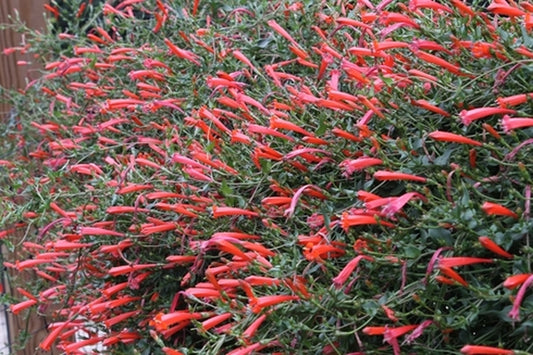
Manettia cordifolia is one of our favorite warm climate vines, yet it's still relatively unknown in gardening circles. Firecracker vine emerges in very late spring and, with the aid of tiny tendrils, sends its equally tiny leaves climbing skyward on anyone or anything nearby. In late summer, the vines burst forth with tiny 1", red-orange blooms (until fall) that look like miniature firecrackers (red with a yellow tip)...irresistible to hummingbirds. Firecracker vine grows just fast enough to be garden-worthy, but not fast enough to be a pest...simply exquisite! We offered this under the incorrect name of Manettia inflata for several seasons. Pot Size: 3.5" (24 fl. oz/709.77 ml)
We first became acquainted with this wonderful asparagus thanks to the late Ferris Miller, founder of Korea's Chollipo Arboretum. The rich, green, lacy foliage makes an easy-to-grow, wonderful textural clump, 2' tall x 3' wide. If pollinated, it will be adorned with bright red berries in late summer and fall. I can think of few plants better to add a textural contrast to the garden. Pot Size: 3.5" (24 fl. oz/709.77 ml)
This South African broom fern really swept me off my feet with its garden performance. Asparagus virgatus is a wonderful winter-hardy evergreen garden addition where an airy texture in sun is needed. The 3' tall upright spikes open into a soft, thread-like, green "broom." Each 3' wide drought-tolerant clump can be used as a textural contrast in the garden, for a long-lasting filler in floral arrangements, or to treat syphilis and intestinal worms. You gotta love those multi-use plants. In September the foliage of Asparagus virgatus is adorned with a multitude (catalog lingo for more than one) of small red berries. Pot Size: 3.5" (24 fl. oz/709.77 ml)