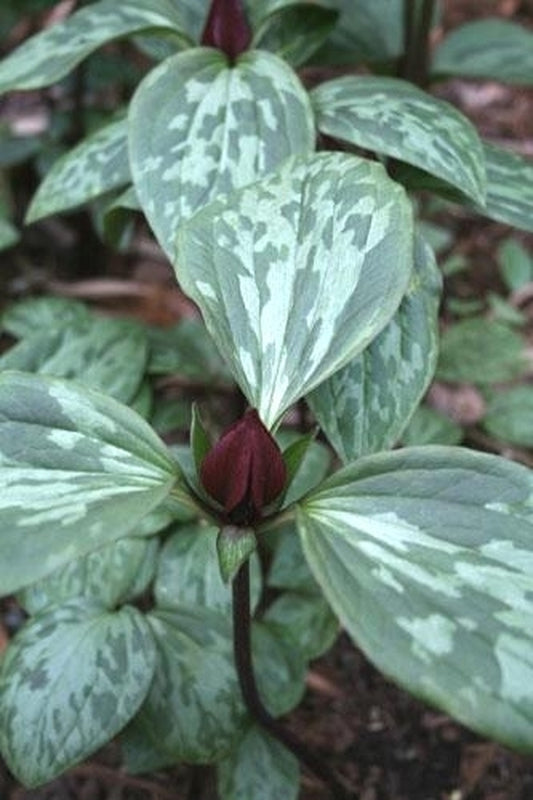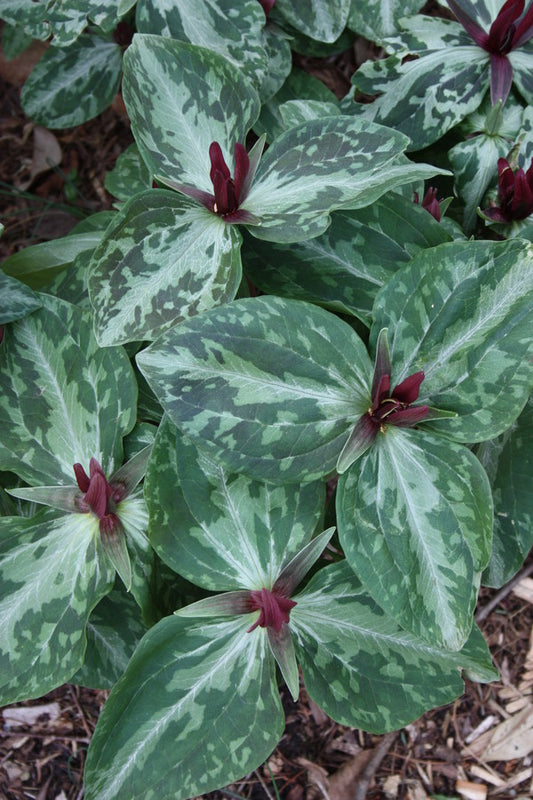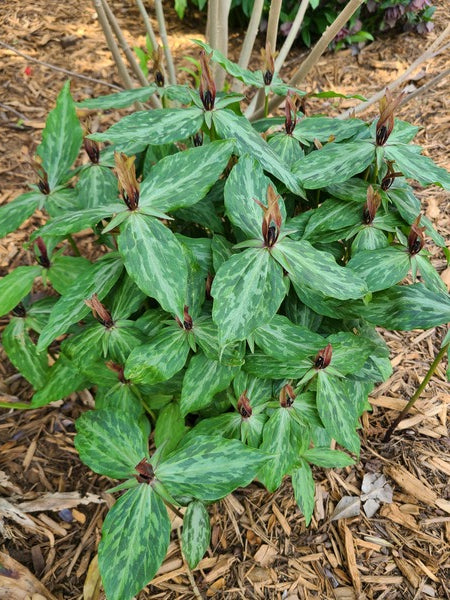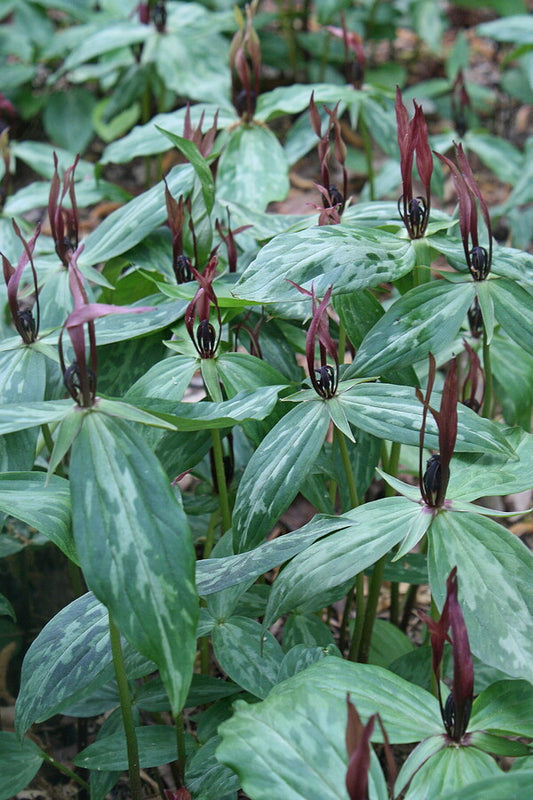
As more and more of our nursery seed-propagated trillium selections reach flowering size, we are able to offer more of these great native woodland perennials to you. We now have nearly 10,000 trillium plants in production, encompassing a range of Southeast US native species.
Read More About Trillium
Plant Delights has one of the largest collections of nursery propagated trillium plants for sale in the country. Despite myths to the contrary, trilliums are easy-to-grow woodland perennials, preferring light shade and a compost-amended garden soil. Try pairing Trilliums with other ephemeral spring flowers like arisaema, woodland phlox or cyclamen. Or pair it with plants that will continue the floral show when the trilliums are done. We suggest Amorphophallus, Calanthe, Tricyrtis or some of the smaller Hosta cultivars.
Trilliums are spring ephemeral perennials, whose yearly life cycle is compressed into a short 6-8 week period in early spring before the trees leaf out. Trillium's ephermeral life cycle does not mean that they have a small impact in the woodland garden. Quite the opposite. The lovely leaves, flowers and architecture of trilliums in springtime leaves an impression that lasts for the rest of the year.
Trilliums have an interesting anatomy....the 3 "leaves" that give trillium plants their characteristic form are actually bracts. The true leaves are greatly reduced structures that surround the underground rhizome. Trillium seeds are also fascinating...they are attached to a nutritious structure called an elaiosome that insects love to eat. When trillium seeds are ripe, ants and wasps carry them to their nests where they consume the elaiosome and leave the seed to germinate...a horticultural win-win situation.
Trilliums are divided into two main groups...the sessile trilliums whose flower sits on top of the leaf, and the pedicellate trilliums, whose flower is attached to the leaf by a short stem (pedicel). One common american native trillium (T. sessile) is even named for this floral trait. We have lots of this species and many others, but they sell out fast.
When you are ready to buy trillium plants for your woodland perennial garden, please check out our list below which includes a wide selection of nursery propagated trillium plants for sale.
Since 1988, Plant Delights Nursery has been the choice of serious gardeners and plant collectors looking for the best and rarest perennial plants. We are pleased to have received the Perennial Plant Association Retail Award in 2011, the American Horticulture Society Commercial Award in 2002, and to have been selected as one of the Best Mail Order Plant Sources - Garden Design Magazine 2010. Welcome to our family of plant lovers!
This plant collectors' moment is thanks to a single clone of yellow-flowering Trillium cuneatum we found in 1998 in Oconee County, SC in the midst of a large population of typical purple-flowered forms. We finally have enough seedlings from the original, which have also flowered yellow, to share a few. We are offering these under the seed strain name, Trillium cuneatum 'Oconee Yellow' Starting in mid-April, this easy-to-grow sessile toadshade produces silver and olive mottled foliage, topped, in this case, with bright yellow flowers. Pot Size: 3.5" (24 fl. oz/709.77 ml)
(aka: Trillium cuneatum A1NC-043) This offering of Trillium cuneatum are seedlings from a plant we discovered in 1998 near Pleasant Hill in Gilmer County, Georgia in a recently logged site where Trillium cuneatum and Trillium decumbens were growing together. What we thought was a potential hybrid turned out to be straight Trillium cuneatum once our seedling crop flowered...obviously the bent stem in the wild was probably due to a falling tree. This vigorous strain appears to be typical Trillium cuneatum except for being much shorter and stockier than normal. The foliage is typical silver and olive speckled leaves topped with purple flowers starting in mid-April (NC). Pot Size: 3.5" (24 fl. oz/709.77 ml)
Trillium flexipes has a large native range, from Minnesota south to Alabama, where it can be found in alkaline soils on forested slopes. In stature, some forms can easily be mistaken for Trillium grandiflorum, Trillium erectum, Trillium cernuum, or Trillium rugelii. Trillium flexipes, which can produce several flowering stalks from a single rhizome, can reach 18" tall when it starts flowering in mid-April (NC). The outward-facing, creamy white flowers are held just above the terminal whorl of green leaves. Our flowering-sized plants are all nursery-propagated from seed from Tennessee's Morgan County region on the eastern end of the Cumberland Plateau...a long and arduous process. Pot Size: 3.5" (24 fl. oz/709.77 ml)
Despite being endemic to only a small region of beech forests and floodplains on both the Louisiana and Mississippi sides of the Mississippi River, Trillium foetidissimum is just as hardy in Minnesota. The amazing sessile trillium sprouts a 10" stalk in early spring, topped first with three olive-green leaves dramatically highlighted with dark blotches. Atop the leaves are the narrow, maroon-red petals. Trillium foetidissimum is extremely easy to grow in a wide range of garden conditions. Our offering represents 5-year-old flowering-sized plants, grown from hand-pollinated seedlings here at PDN. The original parent clone for this offering was collected outside Baton Rouge, Louisiana. Pot Size: 3.5" (24 fl. oz/709.77 ml)
(T. ludovicianum A2LA-006) This offering represents seed grown plants from a population we discovered in 2003 in Smith County, Mississippi, where Trillium ludovicianum and Trillium cuneatum grew together in low, moist flood plains. When we first saw these in the wild, we were pretty sure they represented natural hybrids between the two species, and after flowering their seedlings, we are even more convinced. The 1' tall stalks of Trillium x ludoviciatum terminate with whorls of silver and olive mottled leaves, topped with narrow red petals which vary within the size and shape range of both parents. Trillium x ludoviciatum usually starts flowering for us around late February to early March. We offered these last year as Trillium ludovicianum A2LA-006 before we made our final determination. These are in very limited supply so, like voting in Chicago, order early and often. Pot Size: 3.5" (24 fl. oz/709.77 ml)
We are ecstatic to offer flowering-sized, nursery seed-propagated plants of the East Coast native (Kentucky to Virginia) Trillium luteum. The seed came from Tennessee's Morgan County region on the eastern end of the Cumberland Plateau. For us, Trillium luteum begins flowering in mid-April (NC) with green and silver flecked foliage, topped with a lemon-scented butter yellow flower...truly one of the most stunning of the genus. In the wild, Trillium luteum is usually found in alkaline soil regions, but we have found it to adapt well to slightly acidic soils. Pot Size: 3.5" (24 fl. oz/709.77 ml)
The region where North Carolina, Virginia, Tennessee, West Virginia, Georgia, and Alabama converge is home to the amazing native Trillium sulcatum, named in 1984. Prior to then, Trillium sulcatum was lumped with Trillium erectum, to which it is similar, except Trillium sulcatum is much more robust, with upturned sulcate (boat-shaped) sepals. In early May, the wine-red flowers open atop the foliage. We are thrilled to be able to offer nursery-propagated blooming-sized plants from seed. Pot Size: 3.5" (24 fl. oz/709.77 ml)
Trillium underwoodii is a stunning Southeast US native trillium from the dry deciduous forests of the deep South including Alabama, Georgia, and the Panhandle of Florida. Despite this range, Trillium underwoodii has remarkable winter hardiness. The stunning, mottled foliage features a dark, medium, and light green checkerboard pattern with a silver streak down the center of each leaf. Emerging in February and March, each petiole is topped with a dark purple flower to 1" tall, contrasting nicely with the foliage. Pot Size: 3.5" (24 fl. oz/709.77 ml)
Trillium sp. 'Jones Gap' is the latest possible new trillium species that was discovered in the upper corner of Northwest South Carolina and Northeast Georgia. In appearance, Trillium sp. 'Jones Gap' is a pure white, erect-flowered dwarf Trillium catesbaei...or as a friend refers to it...Trillium catesbaei WTF. We visited the population a few years ago, where it grows among Trillium cuneatum at 1600' elevation. We only have a very limited number of these nursery-propagated flowering-size seedlings available. Pot Size: 3.5" (24 fl. oz/709.77 ml)
In our garden we originally planted divisions of two forms of Trillium lancifolium near each other...one from northern Florida and another from northern Georgia. Six years ago, we gathered the first garden seed from these and when the seedlings finally flowered in 2012, we discovered the after affects of some horticultural hanky panky. The offspring, which we named Trillium 'Shotgun Wedding' (it's a southern thang), represents a cross between both forms. The offspring are slightly taller at 10" and much more vigorous than either parent. Additionally, our new strain has much better leaf patterns than the Georgia parent. Each seedling is different...we could go crazy making special selections, but instead we're going to allow you to do the same. Pot Size: 3.5" (24 fl. oz/709.77 ml)
This superb form of Trillium recurvatum hails from our 2004 accession from Nacogdoches County in east Texas at the high elevation of 355'...at least that's high in east Texas. This offering represents divisions from our five original single rhizomes, indicating the speed at which this form offsets. The foliage of Trillium recurvatum 'Arcadia' is heavily mottled silver and olive...much nicer than any of the Midwestern US genetics we've grown. Trillium recurvatum 'Arcadia' is topped in late March (NC) with short dark purple flowers emerging from the top of the foliage...a vigorous grower! Pot Size: 3.5" (24 fl. oz/709.77 ml)
(aka: Trillium A11NC-093) Trillium x ludoviciatum 'Cairns' represents our nursery seed grown plants from our original collection of what we now believe to be another hybrid swarm of Trillium cuneatum x Trillium ludovicianum that we discovered near the remote north Alabama town of Cairns (Morgan County) at 900' elevation. The leaves are nicely patterned silver and green and the violet purple petals range from narrow to wide. Pot Size: 3.5" (24 fl. oz/709.77 ml)
(aka: Trillium x ludoviciatum A2LA-010) This offering of Trillium x ludoviciatum (Trillium ludovicianum x Trillium cuneatum) represents nursery grown, flowering-size seedlings from our original collection in Rankin County, Mississippi, where we found the natural hybrids growing. The leaves are nicely patterned olive and silver and topped with flowers whose petals range from narrow like Trillium ludovicianum to wide at the tips like Trillium cuneatum. Pot Size: 3.5" (24 fl. oz/709.77 ml)