

Introduction to Fairy Flowers
Epimediums are exotic little plants known by several common names such as fairy wings, bishop's hat, and my personal favorite, horny goat weed. In Asian cultures, Epimediums are used as herbal medicines to stimulate androgen hormones and therefore enhance sexual desire, erectile dysfunction, and to provide energy. This use was reportedly discovered after a farmer noticed goats which grazed on Epimediums became much more sexually active. It is with mixed feelings that one passes bushels of dried Epimedium roots in a roadside market on the way to a high peak in Asia ... I'm sure they provided much enjoyment for the indulging parties, but at great expense to the preservation of many of these species.
It was 40+ years into my gardening life before I got involved with epimediums, partially because I found the conflicting information made them more confusing as a group. It was only with the assistance of Epimedium guru, Darrell Probst, that I was finally able to wrap my arms snugly around this group that we have since embraced. Epimediums are members of the barberry family which includes such other familiar garden plants as mahonia (lumped by some into berberis), berberis, podophyllum (mayapple), and vancouveria.
In the late Professor William Stearn's first Epimedium monograph in 1938 (updated just before his death in 2001), only 21 species were known. Even as late as the early 1990s only a handful of these known species were represented in cultivation by living specimens. As we would soon discover, far less than half of the Epimedium species had even been discovered or named.
Few genera of plants have seen such a dramatic increase in new species, primarily thanks to the work of Mikinori Ogisu of Japan and Darrell Probst of Massachusetts. Most of the Epimedium species discovered and introduced in the 1990s were due to the work of the tireless, Ogisu. His discoveries include Epimedium campanulatum in 1996. 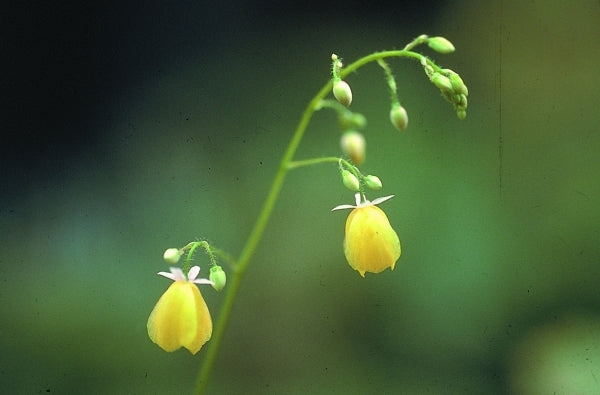
Epimedium campanulatum
Epimedium chlorandrum (1997), Epimedium dolichostemon (1993), Epimedium flavum (1995), Epimedium fangii (1995), Epimedium franchetii (1996), Epimedium ilicifolium (1998), Epimedium latisepalum (1993), Epimedium ogisui (1993), Epimedium mikinorii (1998), Epimedium rhizomatosum (1998), and previously named species that were not in cultivation such as Epimedium brevicornu, Epimedium ecalcaratum (1991), Epimedium fargesii, Epimedium lishihchenii (1997), Epimedium pauciflorum, and Epimedium platypetalum. Probst's introductions include Epimedium brachyrrhizum (1997), Epimedium dewuense (2003), Epimedium epsteinii (1997), Epimedium myrianthum (1998), and the previously described Epimedium sutchuenense which he introduced to cultivation. Many yet to be published species from his work are in the pipeline.
As of 2008, our collection had swelled to 49 of the currently named 54 species, along with most of the distinct hybrids. Epimediums are quite the promiscuous bunch, with bees creating both garden hybrids and well as natural hybrids in the wild. While most Epimediums make great garden plants, there are a few that offer little for gardeners, and these will not be discussed here. For the purpose of this article, I'm grouping my descriptions based on the plant morphology ... plant characteristics that are easily observable, especially flowers.
Epimediums spread via a woody rhizome, located just below the soil surface. Just like bamboos, there are fast spreaders (leptomorphs), and slow spreaders that appear to form a tight clump (pachymorphs). In the garden and nursery, Epimediums can be divided, which is best done after flowering has finished. One of the most important tricks I learned from Darrell Probst is to always leave two-thirds of the foliage on the newly divided plants to encourage them to form new roots. The tight clumping pachymorphs will be the most challenging to divide, hence the higher price these usually demand. If you decide to try dividing them, get a pair of bonsai scissors. Roots on divisions should be cut back to 4-5" long. Epimediums can be grown from seed, but you'll need to have a keen eye since the seed usually matures about 45 days after pollination (Probst). I tried for years to gather seed, which must be sown fresh, with no luck and now I just allow the seed to fall into a well prepared seed bed, where it will germinate the following spring. If you're lucky enough to gather the seed, they will require 60 days below 40 degrees F for germination. We have been able to flower about 10% of one year old seedlings with the rest flowering the second year. Since most Epimediums are self-sterile, a lot of your offspring will be hybrids, creating a myriad of possibilities where many different species are grown nearby.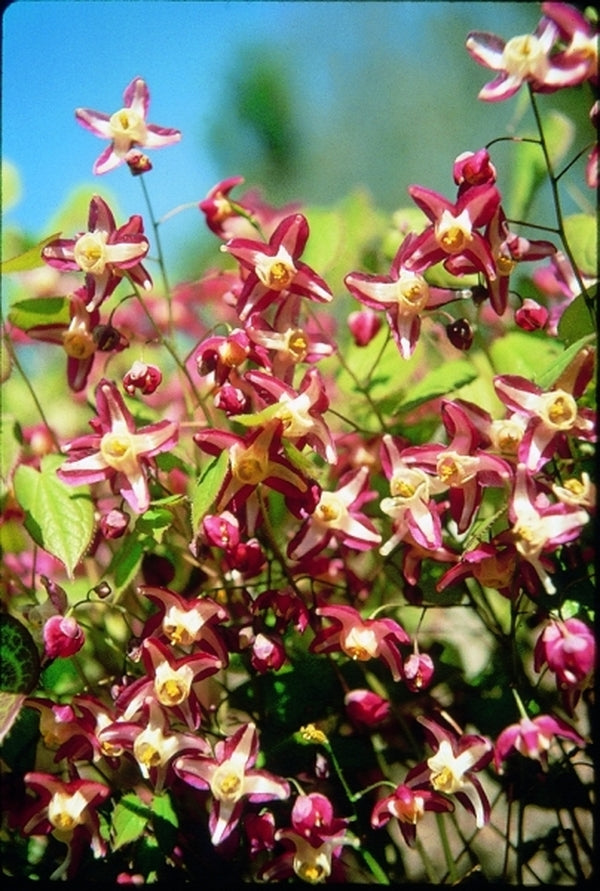
Epimedium x rubrum
In gardening circles, Epimediums are known as great plants for dry shade, but in the wild, most grow in very moist soils, with many being found near woodland waterfalls. While Epimediums will indeed grow in dry shade, they fare much better in part sun to light shade with a rich, organic, moisture-retentive soil. As with all plants, stay away from salt-based fertilizers which can burn Epimediums when used in excess. Plants such as Epimedium x rubrum, Epimedium x warleyense, Epimedium x perralchicum, Epimedium pinnatum ssp. colchicum, and Epimedium x versicolor seem to be particularly durable in very dry sites. Most Epimediums are native to alkaline soils, so we recommend a soil with a pH between 6.2 and 6.5 that allows us to grow all species well. According to Dan Hinkley (Pacific Horticulture, 1997), the cultivars of Epimedium grandiflorum do not fare well in alkaline soils.
Most Epimediums are spring flowering, with a few species such as Epimedium rhizomatosum and Epimedium davidii continuing sporadically through the summer. I have categorized them into flowering times in the chart (Chart #1) below with some beginning as early as early March (NC- Zone 7b) and other not starting before late April. In areas subject to late spring frosts, the flowering spikes of many of the early flowering Epimediums will need to be protected if temperatures drop below the mid-20s F.
Some Epimediums have evergreen foliage, while others are completely deciduous. As a rule, the deciduous species are more winter hardy than those that retain their foliage. When planting them in the garden, keep in mind that just because the foliage is evergreen doesn't mean it will look great throughout the winter. For us, severely cold winters can damage evergreen foliage that in some mild years may look fine. Most gardeners trim any remaining damaged foliage in mid-late February, before the new flower spikes begin to emerge. While many Epimediums are grown primarily for their flowers, several of the newer species and hybrids are worth growing for their lovely foliage. 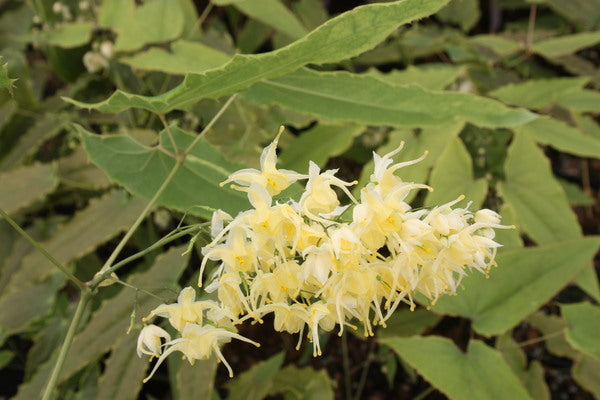
Epimedium wushanense
Epimedium wushanense has superb mahonia-like leaves, while Epimedium acuminatum and Epimedium x omeiense are a couple of species with wonderful leaf mottling. Some selections of Epimedium x youngianum emerge purple or with a red border, as does Epimedium grandiflorum v. higoense. The leaves of Epimedium x versicolor are a kaleidoscope of colors as they emerge.
Below, I have categorized species by their plant form and flower types in order to help you select the best plants for your site.
Small Epimediums with small/medium sized flowers
If you're looking for small and dainty in the Epimedium world, the deciduous Japanese Epimedium diphyllum is for you. This cute garden plant has been in cultivation since the mid 1800s and ranges in flower color from light pink to white. Epimedium diphyllum (Zone 5-8) is represented in cultivation primarily by three cultivarsEpimedium 'Nanum' (white flowers), Epimedium 'Roseum' (pink flowers), and Epimedium diphyllum 'Variegatum' (speckled leaves). The 8"tall flower spikes contain between 2 and 6 flowers each ... certainly nothing to match the showier species. The fading flowers are topped by a second flush of spring foliage. I would consider Epimedium diphyllum to be a clumping species, but one which can make a 2' wide, easily dividable clump in 7 years. Epimedium diphyllum and the evergreen Epimedium sempervirens have naturally hybridized to produceEpimedium x setosum, which is intermediate between both parents.
Mid-sized Epimediums and hybrid groups
Next are the most familiar group of Epimediums ... mid-sized plants that represent what most folks typically think of as epimediums. Plants in this group average around 18" tall x 18" wide and are composed of several species and hybrid groups. From smallest to largest, they include Epimedium sempervirens, Epimedium x youngianum (Epimedium diphyllum x Epimedium grandiflorum), Epimedium grandiflorum, Epimedium koreanum, and a series of interspecific hybrids. Plantsman Darrell Probst has interesting theories on these confusing groups and their origin that he will hopefully publish one day.
Epimedium sempervirens (Zone 5-8) is a similar Japanese species to Epimedium diphyllum, except for having evergreen (from Zone 7 south) foliage, larger flowers and about 1/3 larger plant size. Epimedium sempervirens produces flower stalks reaching 12-15" tall with 6-10 flowers each, also in colors ranging from white to lavender. Epimedium sempervirens is usually a tight clumping species, although some forms can spread a bit. Another trait of Epimedium sempervirens is the new leaves often emerge with a lovely red flush. Epimedium sempervirens is represented in the trade by
Epimedium 'Candy Hearts (red edged leaves and pale lavender), Epimedium 'Cherry Hearts' (red edged leaves and white flowers), Epimedium 'Mars' (red-purple flowers), Epimedium 'Okuda's White' (white flowers), and Epimedium 'Violet Queen' (red-flushed foliage and light lavender flowers). The major drawback to Epimedium sempervirens is the tendency of the second spring flush of foliage to obscure the flowers. 
Epimedium sempervirens 'Candy Hearts'
Epimedium x youngianum represents a large group of hybrids between Epimedium diphyllum and Epimedium grandiflorum. A few forms are tardily deciduous, indicating that some hybrids attributed to this group may not belong here. Epimedium x youngianum is represented by a large number of hybrids in the trade including, Epimedium 'Baby Doll Pink' (small clump with small pale pink flowers), Epimedium x youngianum 'Be My Valentine' (very floriferous clump with dark pink sepals with a white cup), Epimedium 'Beni-kujaku' (light lavender flowers), Epimedium 'Capella' (pink sepals and white spurs), Epimedium 'Fairy Dust' (small light pink flowers),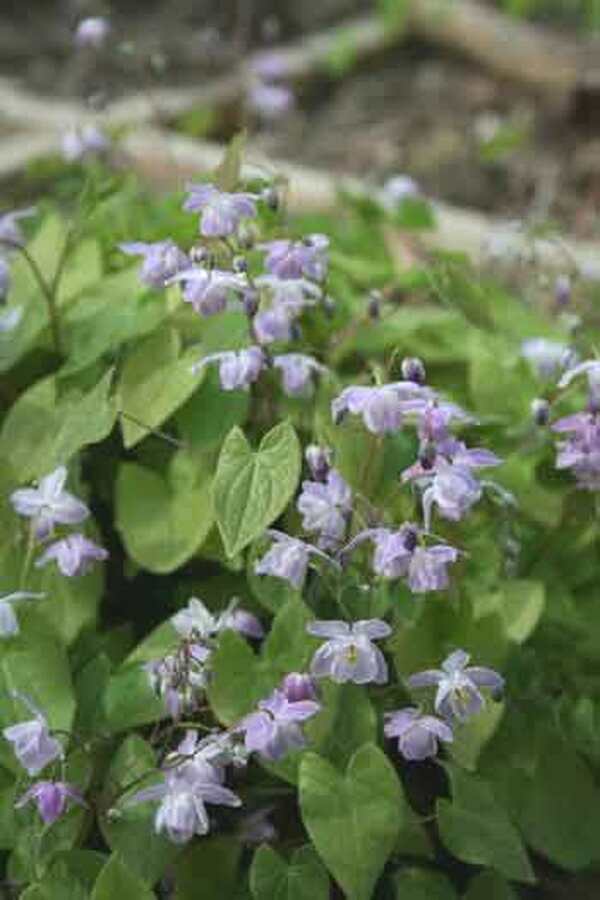
Epimedium x youngianum 'Grape Fizz'
Epimedium 'Grape Fizz' (small light lavender flowers), Epimedium 'Liliputian' (very dwarf white with nice white flowers), Epimedium 'Milk Chocolate' (chocolate mottled leaves and white flowers), Epimedium 'Milky Way' (white), Epimedium 'Murasaki Shikibu' (purple sepals and white spurs), Epimedium 'Pink Star' (pale pink, nearly white), Epimedium 'Purple Heart' (bronze leaves and white flowers), Epimedium 'Royal Flush' (reddish bronze foliage and light pink lavender flowers), Epimedium 'Ruby Tuesday' (pink spurs with a violet cup),
Epimedium x youngianum 'Tamabotan' (purple foliage and light lavender flowers)', Epimedium 'White Cloud' (small clump with white flowers), and Epimedium 'White Star' (white flowers). We find each of these to be dramatic improvements over Epimedium x youngianum 'Niveum' and Epimedium x youngianum 'Roseum'. Some clones of Epimedium x youngianum also have a second flush of foliage that obscures the flowers, but the problem isn't nearly as prevalent as in Epimedium sempervirens or Epimedium diphyllum. As expected, Epimedium x youngianum is usually intermediate between the spreading clumps of Epimedium diphyllum and the tight clumps of Epimedium grandiflorum.
Epimedium grandiflorum (Zone 4-8) is a winter deciduous Japanese species that represents the majority of the Epimedium cultivars in commercial trade. Like Epimedium sempervirens, most forms are tight clumpers, although a few may have longer rhizomes. Many of the earlier selections of Epimedium grandiflorum have large flowers produced among or just slightly atop the foliage, usually obscured by the second spring flush. Selections of E. grandiflorum in the trade include
Epimedium grandiflorum var. higoense 'Bandit' (dwarf plant with red-edged leaves and white flowers),
Epimedium grandiflorum 'Benedict's Violet' (lavender flowers),
Epimedium grandiflorum var. violaceum 'Bronze Maiden' (chocolate foliage and light lavender flowers),
Epimedium 'Cranberry Sparkle' (chocolate new leaves and cranberry red flowers),
Epimedium grandiflorum 'Dark Beauty' (chocolate leaves and white cup and spurs/purple outer sepals),
Epimedium 'Lavender Lady' (dark purple buds opening to light lavender flowers),
Epimedium 'Lilafee' (bronze mottled foliage and lavender purple flowers),
Epimedium grandiflorum 'Pierre's Purple' (dark purple flowers),
Epimedium grandiflorum 'Princess Susan' (white cups and spurs with purple outer sepals),
Epimedium grandiflorum 'Purple Prince' (dark purple cup with light lavender spurs),
Epimedium grandiflorum 'Red Queen' (carmine red),
Epimedium 'Saxton's Purple' (light lavender flowers),
Epimedium 'Silver Queen' (white flowers),
Epimedium 'Spring Wedding' (red edged leaves, pale lavender flowers),
Epimedium 'Swallowtail' (red edged leaves and light lavender flowers),
Epimedium grandiflorum 'Tama-no-gempei' (white cups and spurs, purple outer sepals),
Epimedium 'Waterfall' (rose purple flower with white spurs),
Epimedium 'Yellow Princess' (light yellow flowers), and
Epimedium grandiflorum 'Yubae' (purple foliage, cranberry flowers).
With the exception of Epimedium grandiflorum 'Swallowtail', the other Epimedium grandiflorum selections don't pick up their nice leaf coloration until after flowering.
Epimedium koreanum 'Harold Epstein'
Epimedium koreanum (Zone 3-7) was long considered a subspecies of Epimedium grandiflorum, but was finally split out as a species on it's own. As the name indicates, it is found in Korea and northern Japan. While most Epimedium grandiflorum outside of Northern Japan where Epimedium grandiflorum var. flavescens resides, Epimedium grandiflorum has flowers of white to purple, while Epimedium koreanum has yellow flowers. Also, the deciduous Epimedium koreanum spreads 6-12" per year via rhizomes compared to the typically clumping Epimedium grandiflorum. In the trade, Epimedium koreanum is represented by two selections, Epimedium koreanum 'Harold Epstein' (light yellow flowers on red stems), and Epimedium 'La Rocaille' (creamy flowers).
Epimedium x rubrum (Zone 4-8) is a name used for a group of semi-evergreen hybrids between Epimedium alpinum and probably Epimedium sempervirens (Probst - Garden Vision catalog 1997). Epimedium x rubrum is most prized for its leaves, which emerge with a stunning reddish margin. The short spikes of pinkish red flowers can be obscured if the old foliage is not removed before flowering. The unnamed clone in the trade is widespread thanks to the fact that it spreads well via rhizomes. A much more vigorous clone named Epimedium 'Sweetheart' was introduced by Darrell Probst. As with Epimedium grandiflorum, the attractive red leaf edges don't occur until flowering is finished.
Epimedium x versicolor (Zone 5-8) is the name for a group of hybrids between the deciduous Japanese E. grandiflorum and the European native evergreen Epimedium pinnatum first raised in the Ghent, Belgium Botanic Garden in the mid 1800s. These hybrids are known for their stunning new foliage, which is chocolate, highlighted by green veins. From Zone 7 south, the foliage remains evergreen, but becomes deciduous as you head further north. The well-spreading Epimedium x versicolor is represented in the trade by Epimedium 'Sulphureum' (evergreen, new foliage brown with green veins, light yellow outer sepals, light yellow spur and cup), Epimedium 'Neosulphureum' (tan new evergreen foliage and creamy sepals with a yellow cup), and Epimedium 'Versicolor' (deciduous, stunning netted new foliage of dark cinnamon, peach sepals with a yellow cup). My favorite of the group is Epimedium x versicolor 'Cherry Tart' (cinnamon foliage and light pink sepals, dark pink spurs, and a yellow-tip cup.
Epimediums with short flower spikes and large spider-type flowers
The next group are evergreen Epimediums that have large flowers in pink to white, but are borne on short flower stalks. 
Epimedium brachyrrhizum
Epimedium brachyrrhizum first described from China in 1997 is similar to another species, Epimedium leptorrhizum (Zone 5-8) that has been known since 1938. Both have spreading rhizomes with Epimedium brachyrrhizum possessing a thicker rhizome, spreading considerably slower. For us Epimedium leptorrhizumnever exceeds 6" in height, while Epimedium brachyrrhizum typically reaches 1' tall. Both evergreen species are topped in early spring with very short flower spikes of 8-12 flowers ranging from pink to lavender, and occasionally white. Epimedium brachyrrhizum (Zone 5-8) is represented in the trade by two hard to find cultivars Epimedium 'Elfin Magic', and soon, the white flowered PDN selection Epimedium 'Little Angels'. The foliage of Epimedium brachyrrhizum turns a nice shade of lavender in the winter. Epimedium ogisui (1993) (Zone 6-9) is a similar spreading evergreen species with near horizontal spikes of large white flowers. The Chinese Epimedium epsteinii (Zone 5b-8), also named in 1997, is a similar evergreen species with short, but spreading rhizomes and short flowers spikes, sporting up to 12 large bicolored inflorescences of purple cups and spurs, backed by a white outer sepal. Plants in this group make superb groundcovers, often with attractive red mottled foliage. 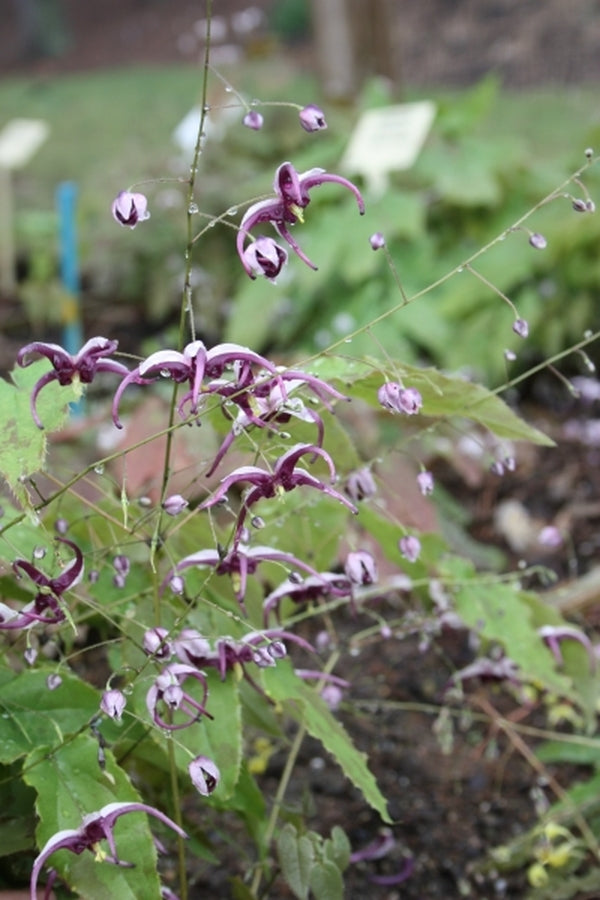
Epimedium acuminatum 'Night Mistress'
Some of the most showy Epimediums are those with large flowers on long spikes. The evergreen Epimedium acuminatum (Zone 5-8) from limestone cliffs in the Southern Chinese provinces of Yunnan and Sichuan leads this list along with its hybrid, Epimedium x omeiense(acuminatum x fangii). Epimedium x omeiense is fairly new to cultivation, first flowering in cultivation in 1982 (W. Stearn 2002). In our studies, the primary easily visible difference is that Epimedium acuminatum has smaller, narrower leaves and is shorter in stature, 12" tall for Epimedium acuminatum, compared to 24" tall for Epimedium x omeiense. Epimedium acuminatum flowers with 18" long arching spikes, each adorned with up to 50 large flowers composed of long dark purple spurs, highlighted by pale lavender inner sepals. The flowers are so large, the spikes can become quite heavy, so much that their tips nearly touch the ground. For this reason, I recommend both Epimedium acuminatum and Epimedium x omeiense be planted atop a berm, so the flowers can be better enjoyed. Both Epimedium acuminatum and Epimedium x omeiense are prized for their long-pointed and wonderfully mahogany mottled leaves. Compared to the tight clumping species, this is a reasonably good spreading species. Heronswood's Epimedium acuminatum 'Ruby Star' (white sepals, lavender spurs, and a purple cup), and Darrell Probst's Epimedium acuminatum 'Night Mistress' (pink spurs, purple spurs, and a purple cup) are the two easiest to find clones on the market. Mikinori Ogisu's wild collected clone of Epimedium x omeiense released as Epimedium 'Stormcloud', Dan Hinkley's 'Myriad Years' (white sepals, light lavender spurs and a purple cup), and the Japanese 'Akane' are the easiest to find in the market.
Epimediums with yellow spider-type flowers
There are a number of evergreen Chinese species with large cream to yellow flowers including Epimedium davidii, Epimedium fangii, Epimedium flavum, Epimedium hunanense, Epimedium franchetii, Epimedium lishihchenii, Epimedium rhizomatosum, Epimedium membranaceum, Epimedium chlorandrum, and Epimedium wushanense. I would consider all of these to make very showy garden specimens.
Although first discovered on limestone cliffs in China around 1869, the garden worthy Epimedium davidii (Zone 5-8) wasn't introduced to cultivation until 1985. There are both tight clumping and slowly spreading forms of Epimedium davidii, both of which hold their spikes of up to 2 dozen curved yellow-spurred flowers above the small spiny green foliage for good visibility. Because new buds that form along the rhizomes and the leaf axils re-flower (Probst, American Nurseryman, 1998), it produces new flowers for us throughout the summer. Epimedium davidii is a superb garden plant deserving more widespread recognition, although it is not a species that performs well in dry locations. The Chinese Epimedium fangii (1995) (Zone 5-8), Epimedium flavum (1995) (Zone 5-8), and Epimedium hunanense (1931)(Zone 5b-8) are similar evergreen species with short flower stalks of bright yellow flowers. These are still little known in cultivation. Epimedium fangii is the fastest spreading of these species, followed by the vigorous Epimedium hunanense and then the dwarf Epimedium flavum. The flowers in this group are much smalller than the rest of the yellow spider group. Epimedium franchetii (1996) (Zone 4-8) and the similar Epimedium lishihchenii (1997) (Zone 4-8) are slowly spreading evergreen species, also recently discovered in China. Both of these species are similar in growth and form to Epimedium acuminatum and Epimedium x omeiense, but with up to 2 dozen large yellow flowers with recurved spurs, held horizontally on sturdy 2' long flower stalks. Both species can produce foliage that emerges with an attractive bronze hue. Although some folks argue that these represent a single species, we find that all of our clones of Epimedium lishihchenii have much larger foliage than Epimedium franchetii. I feel that the cultivar Epimedium franchetii 'Brimstone Butterfly' actually belongs to Epimedium lishihchenii. Epimedium chlorandrum(1997) (Zone 5-8) is a similar slowly-spreading species native to Sichuan and also resembles Epimedium acuminatum, but the flowers are creamy yellow on 2' long arching spikes.
Another group of yellow spider-flowered Epimediums include Epimedium rhizomatosum, Epimedium membranaceum, and Epimedium ilicifolium. For us the Chinese Epimedium rhizomatosum (Zone 5-8) flowers longer than any other species, often reblooming throughout the summer. As the name would indicate, Epimedium rhizomatosum, named in 1998, spreads via long rhizomes, as compared to the shorter rhizomes of the similar looking Epimedium membranaceum (1922). Epimedium rhizomatosum is adorned with short 15" long flower stems of large-spurred yellow flowers. Epimedium membranaceum (Zone 5-8) is a similar species with up to 30 large-spurred yellow flowers on 2' long stems. Epimedium membranaceum is a superb garden specimen that starts flowering just as Epimedium franchetii ends and continues all summer, thereby extended the flowering season. The third and smallest of the group is Epimedium ilicifolium, a smaller growing (1' tall x 2' wide in 3 years) plant, composed of narrow, spiny green leaves. Despite its small stature, Epimedium ilicifolium is one of the most floriferous of the group with light yellow flowers that are tightly packed along the flower spike as compared to the wide spacing of Epimedium rhizomatosum and Epimedium membranaceum. 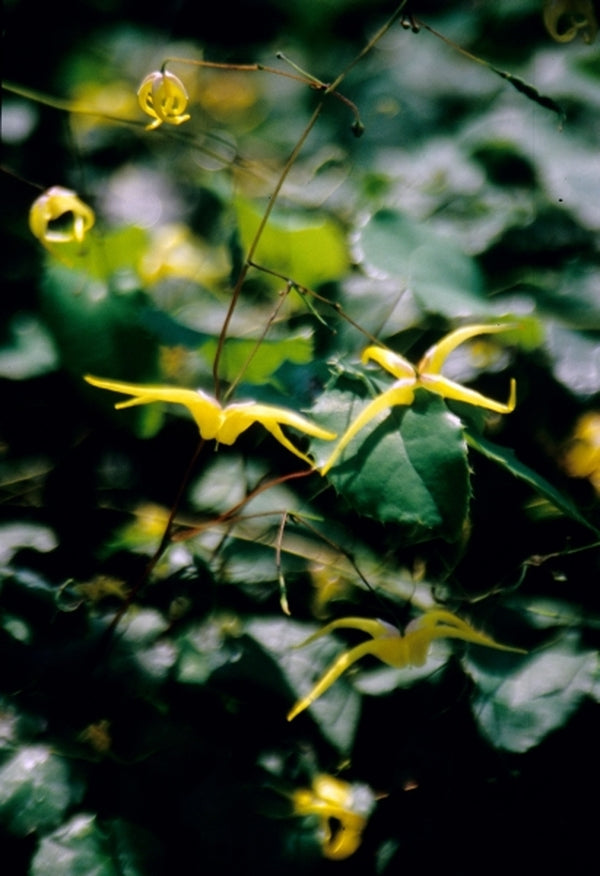
Epimedium membranaceum
As best I can determine, the slowly spreading Epimedium wushanense (Zone 5-8), although named in 1975, wasn't sold before 2000. My prediction is that it won't be long before this becomes one of the most popular garden species. The long, spiny evergreen leaves (nicely mottled in some clones) up to 8" long come through the winter in great shape (NC), and serve as a nice background for the spikes of up to 100 long-spurred creamy-yellow flowers. The entire flowering spike can reach nearly 3' in height. The flowers are bunched closely together and held just above horizontal on a very sturdy spike.
Epimediums with small yellow bell-shaped spurless flowers
For something a little more dainty, there are yellow-flowered species without the long spurs of the group above. Epimedium platypetalum (1922) (Zone 5-7) is a cute semi-evergreen Chinese species with spreading rhizomes and small yellow spurless bell-shaped flowers along 1' tall flowering stems. Two other little known, but similar Chinese species with compact rhizomes areEpimedium ecalcaratum (1991) (Zone 5-7) and the clump-forming evergreen Epimedium campanulatum(1996) (Zone 4-7a), topped in spring with 2' flower stalks of small yellow bells.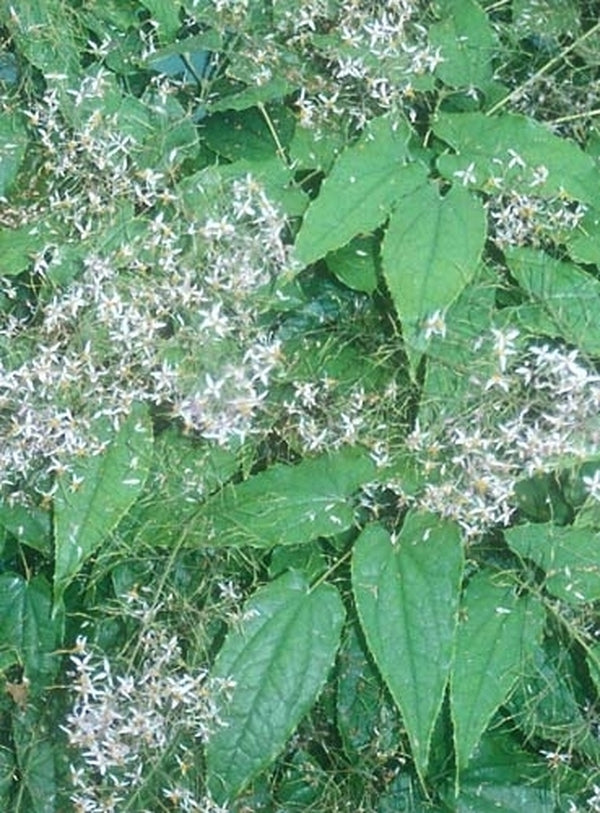
Epimedium pubescens
Epimediums with tiny white flowers
You'll never hear this next group decried as showy, but I would not be without these in my garden for their understated charm. The clumping, evergreen Epimedium sagitatum (1877) (Zone 5-8) is one of many Chinese species with tiny flowers, but the feature to recommend is the attractive cinnamon colored leaves as it emerges. The only cultivar of Epimedium sagitatum in the trade isEpimedium 'Warlord', a plant that is worth growing for it's exceptional red and tan flushed new foliage. Epimedium myrianthum (1998) (Zone 5-8) is similar to Epimedium sagittatum, except the former usually has red tinted foliage, while the latter is often mottled and Epimedium myrianthum has a much larger number (up to 150) of tiny flowers. Epimedium myrianthum, which can often rebloom in summer, is represented in the trade by the stunning foliaged Darrell Probst introduction, Epimedium 'Mottled Madness'. Epimedium pubescens (1877) (Zone 6-8) is a similar evergreen species with slightly larger flowers. Unlike the previous two, Epimedium pubescens comes in both a clumping and a creeping form. Epimedium stellatum is relatively new, being introduced to cultivation in 1983 and only named in 1993.Epimedium stellatum(Zone 5-8) is similar to the above three species, but with even larger flowers on a 20" tall stalk that gives it considerably garden value. The most common cultivar of Epimedium stellulatum in the trade is Roy Lancaster's dwarf 1' tall 1983 Chinese collection,'Wudang Star' and a taller 20" tall clone known simply as "long leaf form". Other species in this group, which are still relatively rare include the Chinese Epimedium truncatum(1990) (Zone 5-8), and Epimedium baieali-guizhouense(1993) (Zone 5-8), each with tiny white flowers.
Epimediums with Dodecatheon-like flowers
Several other favorites that don't resemble any of the aforementioned species are the clumping evergreen species Epimedium fargesii (1894) (Zone 5-8),Epimedium dewuense (2003) and the slowly spreading evergreen Epimedium dolichostemon (1988)(Zone 5-8). In flower, these more closely resembles a dodecatheon (shooting star). I find Epimedium fargesii to be of the most elegant, understated of all the fairy wings ... unfortunately, the lack of commercial demand will probably keep it rare. Epimedium fargesii is represented by the cultivarsEpimedium 'Pink Constellation', Epimedium 'Pink Treasure', and Epimedium 'Star Shower'. Epimedium dolichostemon which has wider spurs is also prized for its wonderfully mottled foliage. Epimedium dewuense is the smallest of the three with flowers that resemble a small Epimedium fargesii.
Other Epimedium Species and Hybrid Groups
Other than the previously mentioned species and groups, there are a couple of others which are fairly widespread in commercial production.
The European Epimedium pinnatum ssp. colchicum(1903) (Zone 5-8) is a lovely evergreen species, best known in the trade by the US National Arboretum collection from near the Black Sea and later named Epimedium pinnatum ssp. colchicum 'Thunderbolt'. In cold weather, the foliage darkens to nearly black with a few green veins. Epimedium x warleyense is a hybrid of Epimedium alpinum and Epimedium pinnatum ssp. colchicum. This is one of the few true orange epimediums. Commonly available cultivars from this cross include Epimedium 'Ellen Willmott', and Epimedium x warleyense 'Orangekonigin'. Epimedium perralderianum (1862) (Zone 5-8) is the only species native to Africa ... Algeria, in fact. The 1' tall stalk, held above the foliage is adorned with up to two dozen large bright yellow flowers. A similar looking hybrid to the parent derived from crossing Epimedium perralderianum with the closely related Epimedium pinnatum ssp. colchicum is Epimedium x perralchicum. This cross, also with long spreading rhizomes as it parents, is represented in the trade byEpimedium 'Frohnleiten' (reddish spring foliage with green veins and only 8" tall, yellow flowers), andEpimedium 'Wisley'.
Epimedium Hybrids
Despite all of the fabulous species and species selections, some of the most exciting new Epimediums are coming from interspecific crosses. I thought I'd share a few of my favorites.Epimedium 'Amber Queen' PP 17,197 is a cross of Epimedium 'Caramel' x Epimedium flavum. This amazing hybrid is topped with large floral sprays of large golden flowers. Also from Robin White's breeding program in the UK is Epimedium 'Pink Elf' PP 17,228. This floriferous hybrid comes thanks to Epimedium pubescens with the other parent in question ... reportedly Epimedium leptorrhizum, but I'm betting on Epimedium grandiflorum. This is the very first Epimediums to flower for us, often starting to bud by early March. The numerous flower stalks create a cloud-like effect of small flesh-colored flowers. 
Epimedium 'Amber Queen' PP 17,197
There are a number of other hybrids of unknown parentage. Some of my favorites including the Japanese hybrid Epimedium 'Yohiki', a later selection with long-spurred white flowers, which have white cups and hot pink sepals. Epimedium 'Spritzer' is a wonderful Epimedium membranaceum hybrid from Darrell Probst with heavily liver-speckled, spiny-edged leaves, topped starting in late March with tall spikes of large yellow flowers with contrasting coral sepals. Another one of my favorites of Darrell's hybrids is Epimedium 'Domino' ... mid-March flowering vigorous 3' wide specimen with nicely mottled leaves, topped with 2' tall burgundy flower spikes that have huge numbers of large white flowers, highlighted by pink cups.
Two others that should soon become more widely available are Robin White's Epimedium 'William Stearn' (long pink spurs and raspberry cups) and Darrell Probst's Epimedium 'Pink Champagne'(red mottled foliage and flowers of long light pink spurs and raspberry cups). These are just a sample of the wonderful hybrids that have just begun to hit the market with more on the way including many from our work here at PDN. 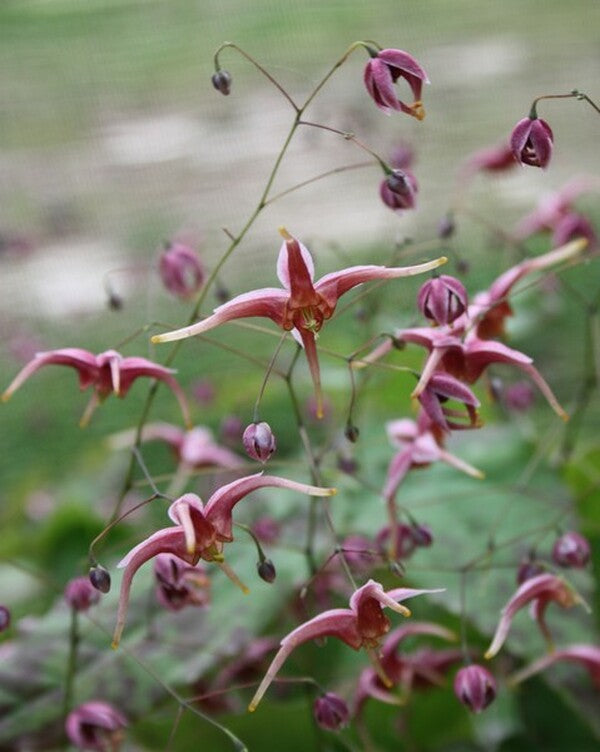
Epimedium 'William Stearn'
I hope you find this group as enjoyable as I have and hope your interest in Epimediums has been "spurred" to new heights. Again, a final thanks to Darrell Probst, without whom this would not have been possible and without whom many of these great Epimediums would never have made it into commerce.
Epimedium Relative Flowering Times
*Flowering times are average in Zone 7b Raleigh, NC (average winter temperatures -15 degrees C (5F) and will be later in colder climates and earlier in others.
Early March - Mid March 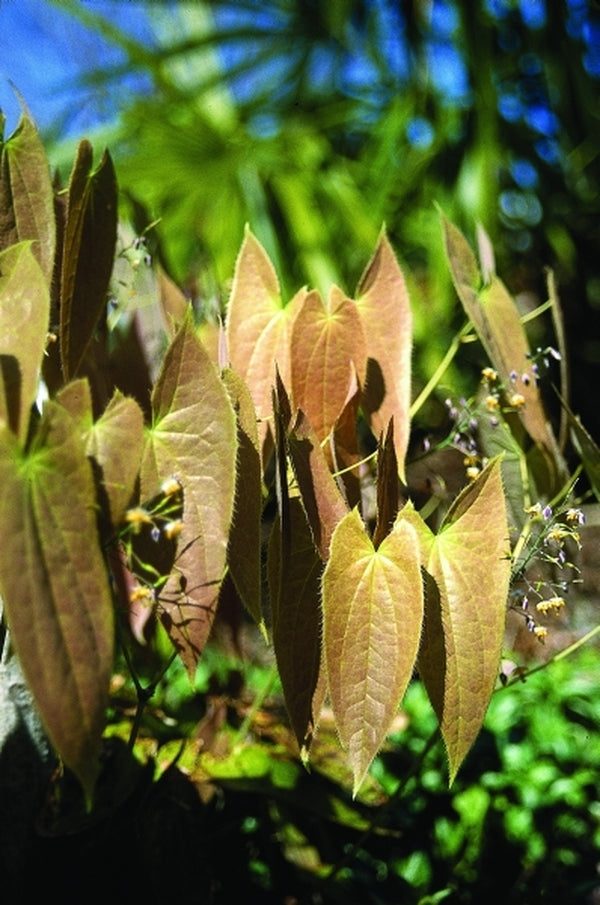
Epimedium sagittatum
E. pubescens - ends late April
Mid March - Late March
E. brachyrrhizum - ends mid April
E. chlorandrum - ends late April
E. epsteinii - ends mid April
E. fargesii - ends mid April
E. franchetii - ends mid April
E. sagitatum - ends early April
E. sempervirens - ends mid April
E. stellatum - ends early May
E. truncatum - ends early May
Late March - Early April 
Epimedium acuminatum 'Ruby Shan'
E. acuminatum - ends early May
E. davidii - ends May - July
E. dolichostemon - ends mid April
E. grandiflorum - ends mid April
E. leptorrhizum - ends mid April
E. lishihchenii - ends mid April
E. myrianthum - ends mid April
E. ogisui - ends late April
E. pauciflorum - ends mid April
E. rhizomatosum - ends mid May
E. x rubrum - ends mid April
E. x setosum - ends mid April
E. x veriscolor - ends mid April
E. x youngianum - ends mid April
Early April - Mid April 
Epimedium hunanense
E. baieli-guizhouense - ends late May
E. brevicornu - ends mid May
E. x cantabrigiense - ends early May
E. diphyllum - ends late May
E. grandiflorum v. higoense
E. hunanese - ends late April
E. ilicifolium - ends late April
E. x omeiense - ends early May
E. x perralchicum - ends late April
E. pubigerum - ends late April
E. x sasaki - ends late April
E. wushanense - ends late April
Mid April - Early May
E. dewuense - ends early May
E. membranaceum - ends August
E. platypetalum - ends early May
E. shuichengense - ends mid May