
Aquatic, Marginal and Carnivorous Bog plants for Damp Soils and Rain Gardens
(Canna lilies, Sarracenia, Hymenocallis, Colocasia, Hibiscus, Iris, Eupatorium, and more)
If you have a soggy area or bog garden, don't drain it! We have marginal aquatic perennial plants for sale that are great for landscaping everything from rain gardens to damp soils. These garden perennials love moist spots and will make you fall in love with perennials that dry soil gardeners only dream of growing. Damp soil plants range from carnivorous plants like sarracenia and bog plants like hymenocallis that need full sun to damp shade plants like hostas and helinopsis. Remember, when you are looking to buy perennials for your damp garden soil, we hope you will check out our listing of damp soil rain garden plants below.
Since 1988, Plant Delights Nursery has been the choice of serious gardeners and plant collectors looking for the best and rarest perennial plants. We are pleased to have received the Perennial Plant Association Retail Award in 2011, the American Horticulture Society Commercial Award in 2002, and to have been selected as one of the Best Mail Order Plant Sources - Garden Design Magazine 2010. Welcome to our family of plant lovers!
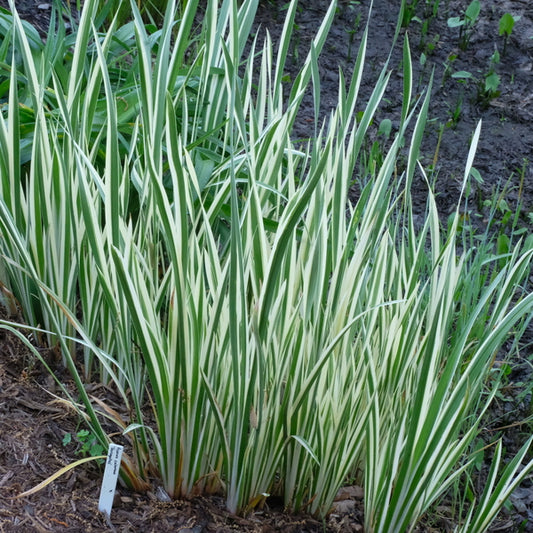
Acorus calamus 'Variegatus' is an aroid relative and former member of the "family" before being ousted by the molecular taxonomy mob. Acorus calamus is now in the horticulture protection program disguised as a dramatic, upright deciduous iris. The vivid white and green banded, deer-resistant leaves of Acorus calamus 'Variegatus' make this one of the most strikingly beautiful vertical accent plants in the garden! Variegated sweet flag spreads slowly by means of a very thick above-ground rhizome. Sweet flag loves a moist spot such as a bog but will also grow in ordinary garden soils...a real easy-to-grow, carefree prize! Pot Size: 3.5" (24 fl. oz/709.77 ml)
Despite the long, tongue-twisting name, the dwarf golden sweet flag is one of the most striking and certainly the cutest of the acorus. The tufts of tiny, golden, ornamental grass-like, evergold foliage make a slowly spreading patch to 2' wide in 5 years. If you get out the magnifying glass, you'll notice the tiny aroid-like tan spadices (flowers) in early summer. Acorus 'Minimus Aureus' is a bright, deer-resistant, dwarf evergreen perennial groundcover in moist shady areas where it makes either a feature specimen or a killer filler between dark stepping stones...a real highlight in the woodland garden. Pot Size: 3.5" (24 fl. oz/709.77 ml)
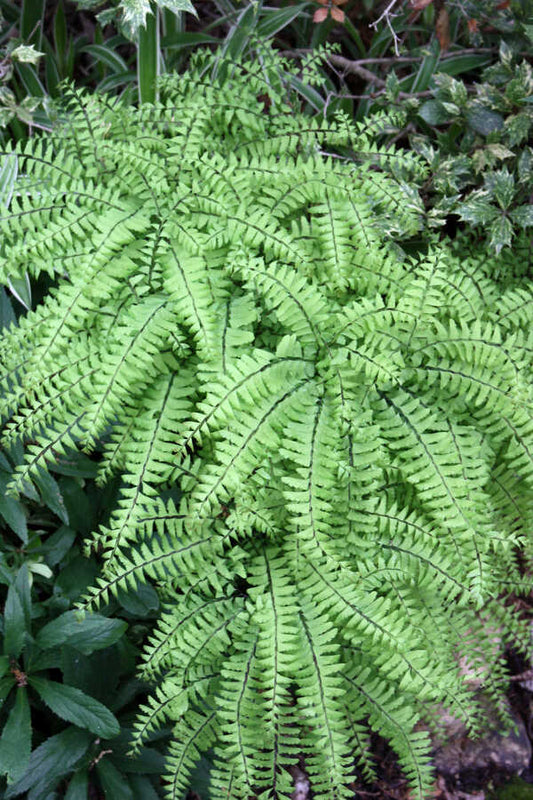
Although the name indicates this fern is from the Aleutian islands, Adiantum aleuticum is native throughout the western United States and into northern Mexico. Adiantum aleuticum can also be found in a few eastern US states (Pennsylvania, West Virginia, and Wisconsin). Adiantum aleuticum is similar in form to Adiantum pedatum with its fan-shaped, finger-like fronds atop a thin black stalk. The cultivar Adiantum aleuticum 'Imbricatum' is a dwarf form of this lovely clump-forming fern that matures at 10" tall, which is about half the height of the typical species. Like Michael Phelps, Adiantum aleuticum is much more robust in a moist environment with a few hours of morning sun. Pot Size: 3.5" (24 fl. oz/709.77 ml)
(aka A1FL-113) This selection of the worldwide native Adiantum capillus-veneris comes from Washington Co., Florida, about an hour west of Tallahassee. Adiantum capillus-veneris 'Falling Waters' has made a splendid patch in our garden with frond pinnae (fern leaflets) that are slightly smaller and narrower than what we typically see in other regional southern maidenhair fern forms. Our five-year-old clumps have spread to 2' wide and so far have survived single digit temperatures with no problems. Pot Size: 3.5" (24 fl. oz/709.77 ml)
(aka: Adiantum capillus-veneris A3T-022) We discovered this wonderfully cut leaf form of the southeastern native Adiantum capillus-veneris along Wasp Creek in Kendall County, Texas. Unlike most forms of southern maidenhair fern, the pinnae are shaped like narrow Japanese hand fans. For us, Adiantum 'Fan Dance' forms a tight 6" tall patch that expands to 2' wide in 5 years. We are pleased to finally be able to share this special form of southern maidenhair fern. Moist soils are best. Pot Size: 3.5" (24 fl. oz/709.77 ml)
(aka: Adiantum c-v A1CR-090) In 2010, we discovered a small patch of Adiantum capillus-veneris growing in a wet seep at 1680' elevation on the south slope of Crete's Mt. Ida...very near an amazing population of white-flowered Dracunculus vulgaris. Our spore collections germinated well enough that we are able to share. The parent clump was more compact than most of the US native forms, maturing around 6" tall. We expect a 2' wide patch in 5 years...we'll find out together. Pot Size: 3.5" (24 fl. oz/709.77 ml)
(coll. #A2T-034) This form of the wonderful southern maidenhair fern, Adiantum capillus-veneris, comes from spores that we collected in 2000 in the Edwards Plateau region of Texas near the town of Rock Springs. Not that you are interested, but we were stopped three times by border patrol agents who searched our backpacks for illegal aliens...glad I carried a small backpack. Plantsman Scott Ogden showed us this population of southern maidenhair fern growing along a small creek in a very alkaline soil. Our 5-year-old clump is 1' tall x 2' wide and, as you can imagine, quite heat tolerant. Pot Size: 3.5" (24 fl. oz/709.77 ml)
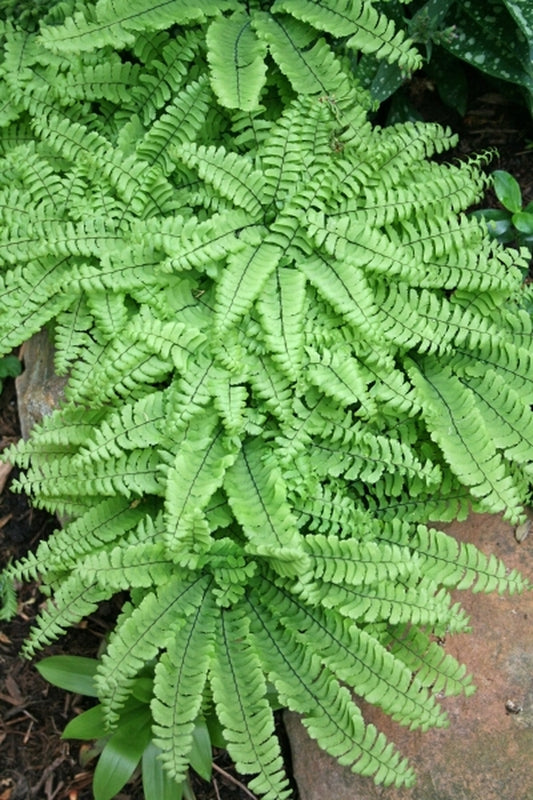
Available 4-18-2013Without a doubt, Adiantum pedatum is one of our most elegant North American native plants. The horizontal horseshoe-like wreath of foliage rests atop 18-24" tall, wiry black stems. Northern maidenhair fern thrives in moist, rich soil, but also grows well in all but the driest of woodland garden sites. The light, airy, fine texture of the Adiantum pedatum fronds serves as a perfect backdrop for hostas and other bold foliage plants. In early April, this deciduous native fern unfurls for a true Kodak moment. In 10 years, expect a 2' wide deer-resistant clump to develop. Pot Size: 3.5" (24 fl. oz/709.77 ml)
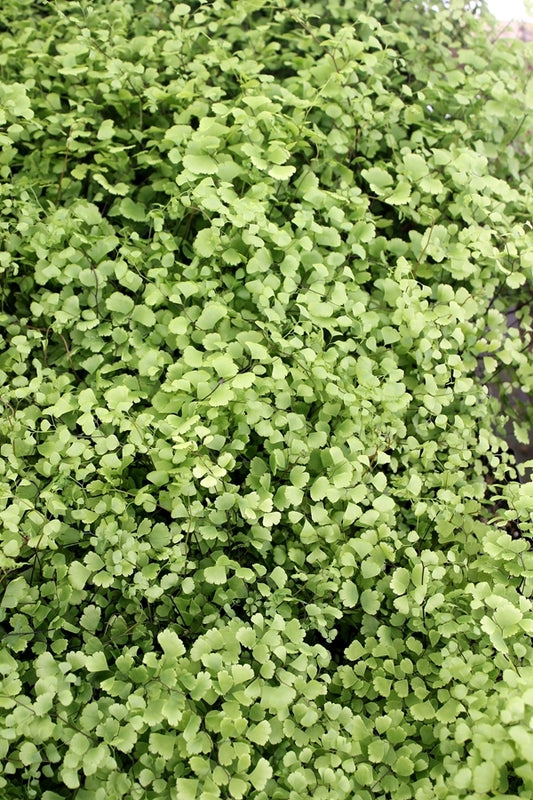
My first experience with the sterile Adiantum x mairisii was in 1993, thanks to a gift from the late fern collector, Nancy Swell of Virginia. Not to be confused with the Chinese Adiantum mariesii, this reported hybrid of Adiantum capillus-veneris and an unknown baby daddy was discovered around 1885 at the UK's Mairis & Co. Nursery and subsequently named by Chelsea Physic Garden curator and fern collector, Thomas Moore. Adiantum x mairisii performs like a vigorous clone of southern maidenhair fern, but with very good winter hardiness. For us, expect a 3' wide deer-resistant patch of 1' tall, lacy maidenhair foliage in 5 years. Pot Size: 3.5" (24 fl. oz/709.77 ml)
Arum hygrophilum is native to Israel, Cyprus, and the Syrian-Lebanon border, where it emerges from summer dormancy in fall with narrow, upright, 2' tall, light green, winter-growing leaves. Despite rumors that it needs frost-free conditions to survive, our plants have thrived since 2004. Arum hygrophilum is adorned, starting in March, with lovely pale green spathes, edged in purple and highlighted by a poorly-endowed, dark purple spadix (male organ). In mild winters, Arum hygrophilum often tries to flower in late January, but cold knocks back the early flowers. In the wild, Arum hygrophilum can be found by moist streambanks and in wet seeps where it grows taller...for us, evenly moist garden soil has been perfect. Pot Size: 3.5" (24 fl. oz/709.77 ml)
This beautiful new UK selection of the giant reed grass adds a new twist to a great deer-resistant garden plant. Arundo 'Golden Chain' was named in the mid-1990s by Liam Mackenzie of the UK's Madrona Nursery as a tissue culture mutation from Arundo donax 'Versicolor'. Arundo 'Golden Chain' forms a clump of 7' tall upright stalks of medium green leaves edged in gold. The color holds all season, unlike the larger and more common Arundo donax 'Versicolor'. Arundo 'Golden Chain' is also a much smaller and less vigorous plant which makes propagation more of a chore, but keeps it in scale with smaller gardens. Pot Size: 3.5" (24 fl. oz/709.77 ml)
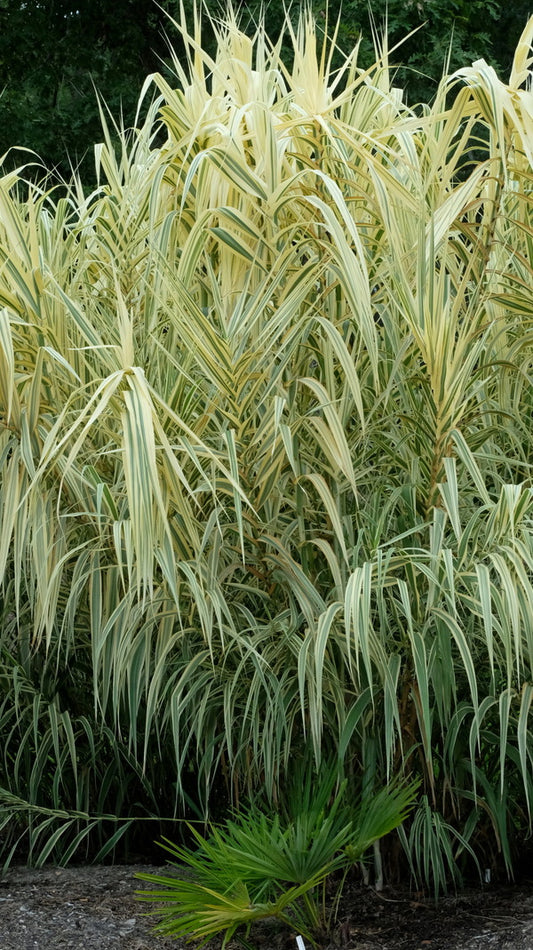
This wonderful deer-resistant grass, native to Mediterranean freshwater wetlands, has long been a favorite of gardeners. The only drawback was the fading of the leaf variegation in warm weather. Arundo 'Peppermint Stick', imported from the Shanghai Botanic Garden by plantsman Greg Speichert, solves that, with striped leaves just as vivid in summer as in spring. Arundo 'Peppermint Stick' forms sturdy 12' tall canes, adorned with wide green-and-white striped leaves. In the fall, the clumps are topped with 18" tall bronze-colored plumes. Arundo may get too large for small gardens, but it is NOT an invasive plant (displacing natives in functioning ecosystems) as I read in some eco-Nazi literature. Pot Size: 3.5" (24 fl. oz/709.77 ml)
One of the real treasures in the genus bletilla is the Chinese Bletilla ochracea. Although not as winter hardy as its cousin Bletilla striata, it more than makes up for this with its stunning jewel-like flowers. The 30" wispy flower stalks emerge from below-ground pseudobulbs and top the iris-like pleated leaves from June through August. Each flower stalk is topped with 3-5 small, creamy yellow flowers, each highlighted with a purple and yellow speckled lip. We have found that Bletilla ochracea prefers more sun to grow well as compared to B. striata which has decent shade tolerance...moist rich soil and morning sun or high filtered light shade are best. Bletilla ochracea 'Chinese Butterfly' is a particularly vigorous, precocious flowering seed strain introduced by Linda Guy of Carolina Nursery. Pot Size: 3.5" (24 fl. oz/709.77 ml)
Bletilla striata is a hardy and very easy-to-grow terrestrial orchid with upright, heavily textured, iris-like, 18" long x 1" wide green leaves that forms a slowly spreading clump. In early spring, stalks to 2' tall of very small cattleya-like flowers are held atop the foliage. The rhizomes spread slowly and eventually form a nice mass. Bletilla striata grows best in moist to damp soils. Pot Size: 3.5" (24 fl. oz/709.77 ml)
Bletilla striata 'Albostriata' is one of the rarer white-edged variegated forms of the commonly grown ground orchid. Two opposite iris-like pleated leaves emerge from each pseudobulb in early spring (April for us). As the leaves emerge, the narrow flower spike arises through the center and opens a few inches above the foliage with rich purple flowers. All Bletilla striata cultivars are amazingly drought tolerant, but grow faster in evenly moist soils. Pot Size: 3.5" (24 fl. oz/709.77 ml)
There are a number of white-edged leaf forms of the hardy orchid Bletilla striata, some without valid names. Our form, Bletilla 'First Kiss', has the same deeply-veined, long green leaves that emerge from a central stem in late March. In late April in NC, the 2' tall stems are topped with small white orchid-like flowers with a flush of purple on the lip. This vigorous grower will quickly make a colony when grown in rich, moist soil. In the South, a bit of mid-day shade is helpful, while full sun farther north produces a better floral show. Pot Size: 3.5" (24 fl. oz/709.77 ml)
This unique variegated form of the hardy ground orchid comes from Japan's famed Gotemba Nursery. The typically long green pleated leaves are streaked with gold and, like the species, the clumps are topped in May and June with 2' tall floral spikes of terminal dark purple flowers...an incredible color combination. Bletilla striata 'Gotemba Stripes' fares well in both dry (once established) and moist soils. Pot Size: 3.5" (24 fl. oz/709.77 ml)
Bletilla striata 'Kuchibeni' is a hard to find but easy-to-grow cultivar from Japan, distinguished by its two-tone flowers. The upper part of the flower is white, while the lip is a contrasting purple. The foliage and growth habit are the same as in the species. I have seen this occasionally incorrectly offered as Bletilla striata 'Alba', which should be solid white. Pot Size: 3.5" (24 fl. oz/709.77 ml)
This unique selection of Bletilla striata has pale lavender flowers with a darker lip which appears bluish to the eye. Knowing most catalog writers are color-blind and that Photoshop® has allowed some catalog writers to now match the plants to their descriptions, I was skeptical about the true flower color. Finally, my plants bloomed and indeed, the color is a real bluish-lavender. As with all bletillas, moist rich woodland soil is best, although this is one tough perennial hardy orchid that will survive almost anything. Pot Size: 3.5" (24 fl. oz/709.77 ml)
Bletilla striata 'Soryu' is a lovely Japanese selection of the hardy ground orchid, topped in late April/early-May with 2' tall flower stalks, ending in a cluster of 1" mauvy-lavender flowers that have a distinctive bluish cast. The contrasting white throat and dark purple lip make a scrumptious garden specimen. Slightly moist soils are best, although bletillas are very easy to grow in a wide range of less than perfect conditions. Pot Size: 3.5" (24 fl. oz/709.77 ml)