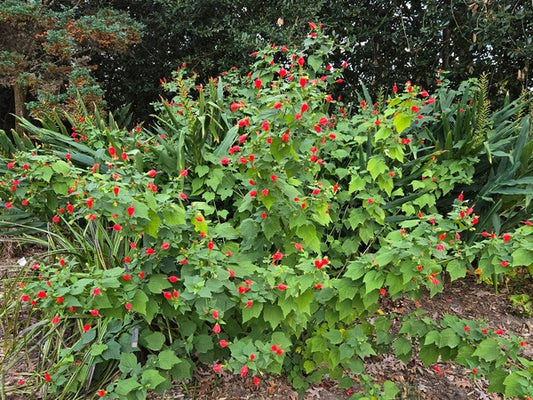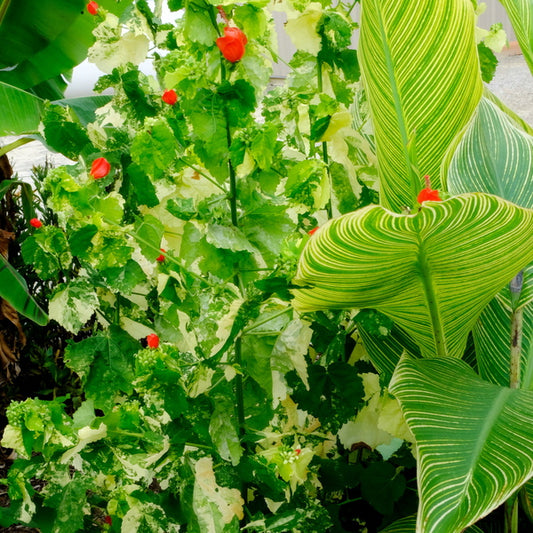
Malvaviscus drummondii is a unique deer-resistant hibiscus relative. This Southwest US native has round green leaves clothing the 5' tall woody stems. Beginning in late summer and continuing through fall, turk's cap clumps are covered with hundreds of cute, brilliant reddish-orange, hibiscus-like flowers with unique swirled petals that never manage to fully open...a hummingbird delight. We advise you to register your malvaviscus as a sex offender since it dangles its sexual organs in clear view of everyone...a seriously exhibitionist plant! Pot Size: 3.5" (24 fl. oz/709.77 ml)
This deer-resistant 2005 introduction from Texan Greg Grant produces flowers that are over 1/3 larger than the typical form. Malvaviscus 'Big Momma' emerges in late spring and quickly rises to 6' tall, topped from midsummer until frost with bright orange flowers, swirled like a turk's cap...attractive to hummingbirds. Sticking out from the end of the floral swirl are the sex organs...and if I do say so, momma is well-endowed and proud of it! Invite 'Big Momma' into your garden for some down-home fun. Pot Size: 3.5" (24 fl. oz/709.77 ml)
This Greg Grant hybrid between Malvaviscus drummondii x Malvaviscus arboreus is a fantastic new color break in one of our favorite mallows. When mature, the deciduous clumps will reach 5' tall x 5' wide. The deer-resistant and hummingbird-favored clumps are adorned with rich green leaves that serve as a backdrop for the axillary flowers that are produced in abundance from midsummer until frost. The turban-like flowers, with their sex organs protruding far outside the petals, make for great conversation in the summer garden. The flowers on Malvaviscus 'Pam Puryear' are a peachy, flesh color instead of the typical bright orange-red. Pot Size: 3.5" (24 fl. oz/709.77 ml)
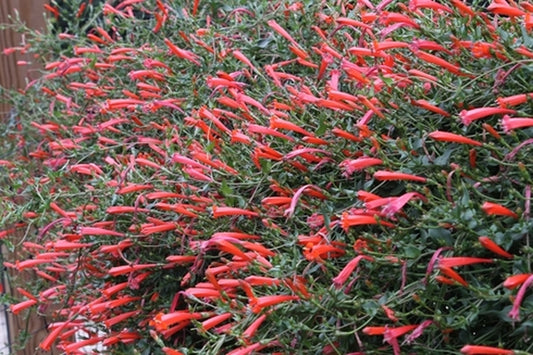
Manettia cordifolia is one of our favorite warm climate vines, yet it's still relatively unknown in gardening circles. Firecracker vine emerges in very late spring and, with the aid of tiny tendrils, sends its equally tiny leaves climbing skyward on anyone or anything nearby. In late summer, the vines burst forth with tiny 1", red-orange blooms (until fall) that look like miniature firecrackers (red with a yellow tip)...irresistible to hummingbirds. Firecracker vine grows just fast enough to be garden-worthy, but not fast enough to be a pest...simply exquisite! We offered this under the incorrect name of Manettia inflata for several seasons. Pot Size: 3.5" (24 fl. oz/709.77 ml)
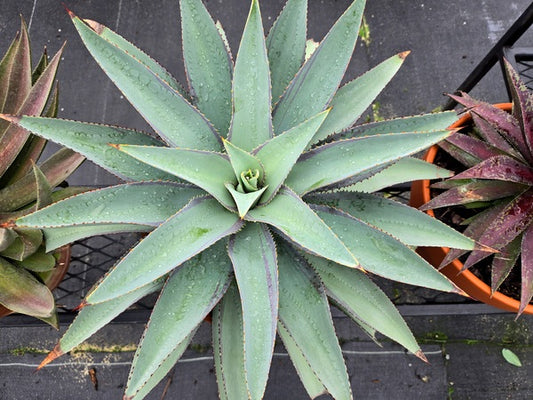
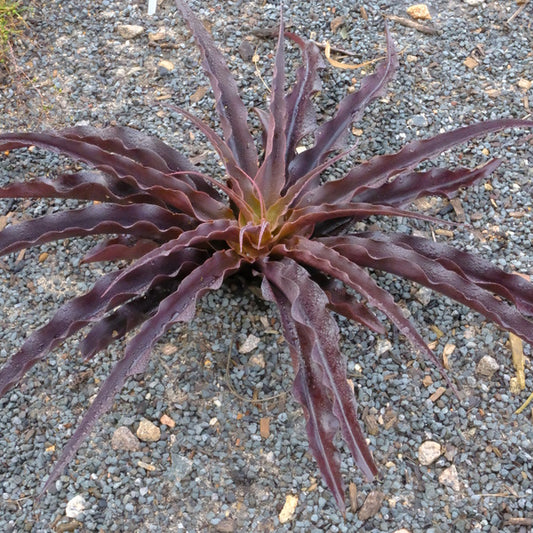
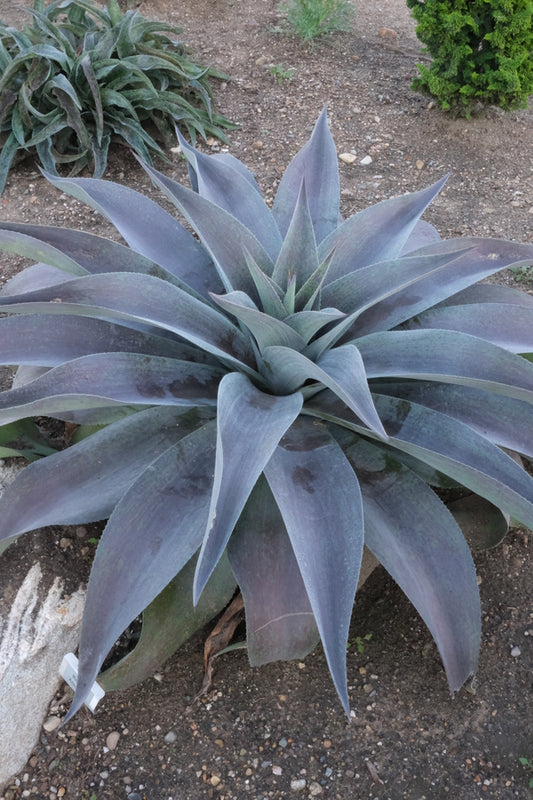
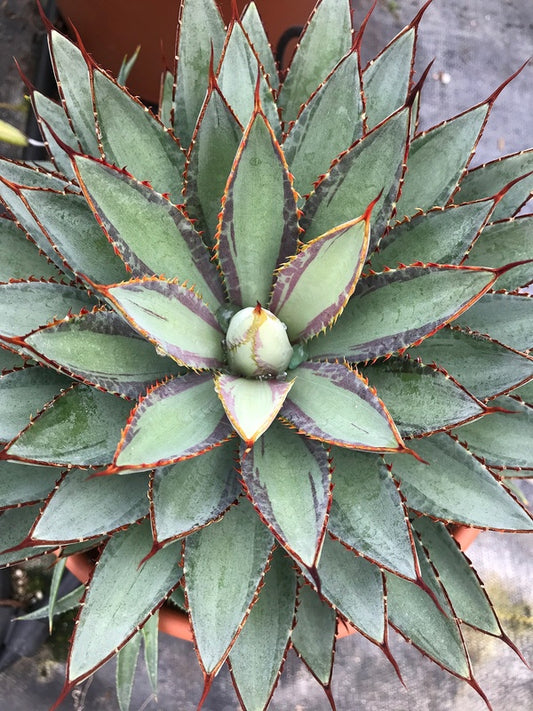
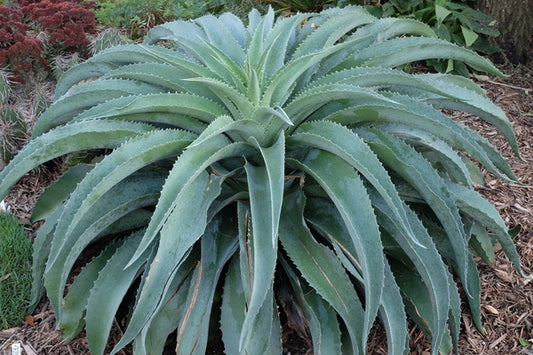
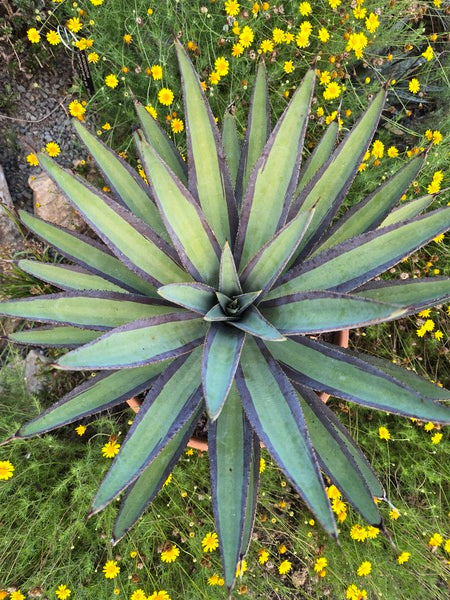
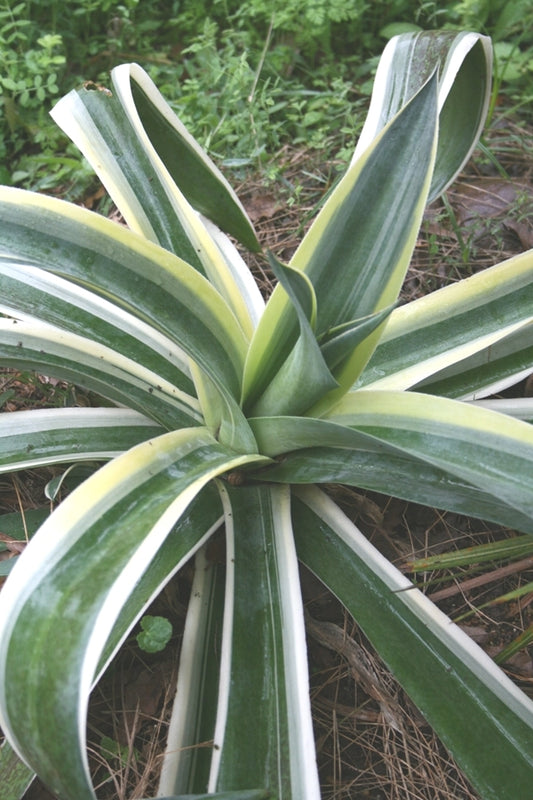
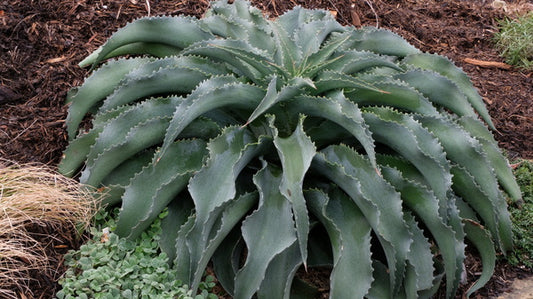
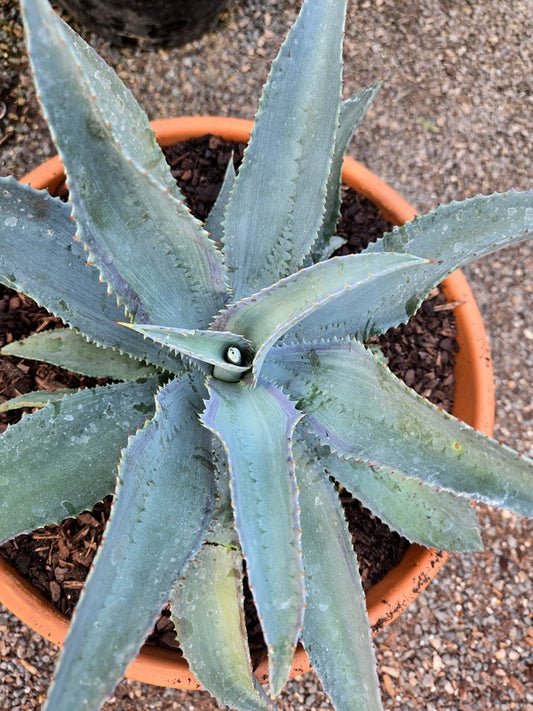
Manfreda guttata 'Jaguar' is an amazing selection of the little known Manfreda guttata...we think this is actually a xMangave. Manfreda guttata hails from 4,000'-8,000' elevation near the town of Tabasco, Mexico (Zacatecas state) and just south. Isn't anything involved with Tabasco going to be excellent? In the wild, Manfreda guttata can reportedly reach 4' tall, but in cultivation, we've never seen anything larger than 2' tall x 3' wide. The fast, but tight offsetting clumps are composed of olive green denticulate (toothed) fleshy leaves that are heavily spotted purple. The tall manfreda-like flower spikes usually occur in September/October. Reportedly, the flowers smell like "that of onions, cooked potato, cooked cabbage, or roast beef." Yeh, right...and I'm a master chef. Our offering is a splendid selection obtained from Dutch master succulent collector, Cok Grootscholten. Pot Size: 3.5" (24 fl. oz/709.77 ml)
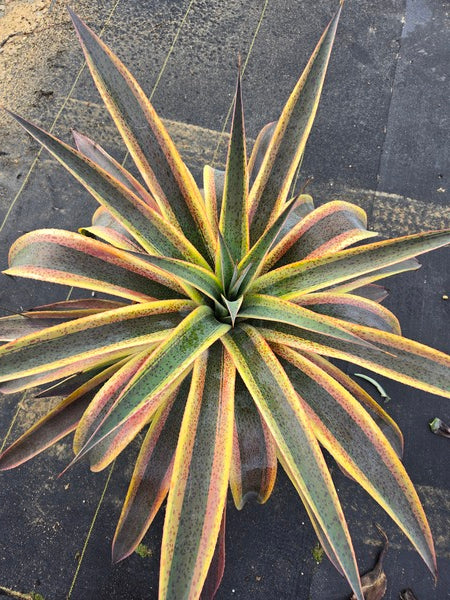
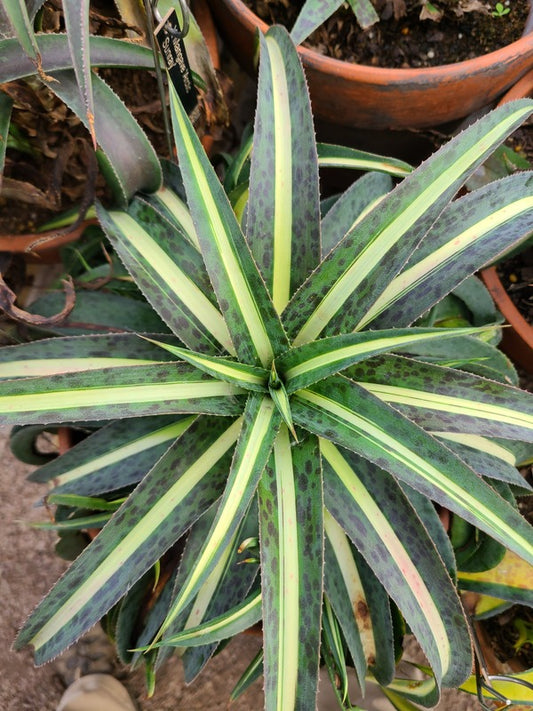
This Sean Hogan introduction is a stoloniferous groundcover manfreda (deciduous agave) that forms 2' wide rubbery rosettes composed of 3" wide glaucous green leaves, each heavily spotted with dime-sized liver colored spots resembling those on my 4-week-old leftovers. In April, the rosettes are occasionally topped with 6' tall spikes of terminally produced alien-looking flowers with greatly extended sexual parts. Manfreda 'Spot' was originally introduced as an Manfreda virginica hybrid which we do not believe to be the case. Instead, this very much resembles some of the north-central Mexican species of manfreda. Our 5-year-old patch is already 5' wide and still expanding. Pot Size: 3.5" (24 fl. oz/709.77 ml)
I nearly fell over when I first saw this amazing manfreda at Yucca Do Nursery. The 1' long, rubbery, lizard-like, wavy, glaucous leaves are heavily spotted chocolate. Each clump lays flat on the ground, radiating out to form a starfish-like rosette. The winter deciduous rosettes are topped with 3' tall spikes of alien antennae-like flowers in June...cool flowers and cool foliage. Well-drained soils are best for this new drought-tolerant rock garden or container gem. Pot Size: 3.5" (24 fl. oz/709.77 ml)
Although it's rarely offered for sale, our native deciduous agave should be grown in every garden where it's hardy. This easy-to-grow, drought-tolerant perennial, native from Illinois south to Florida, makes a flat rosette of fleshy green leaves, often spotted liver-purple. Amazingly, Manfreda virginica has also thrived for years in southern Minnesota gardens. In midsummer, Manfreda virginica rosettes are topped with 6' tall flower spikes, ending in a floral cluster of amazing, tubular purple flowers with huge yellow anthers (related to tuberose). We have found these to be especially loved by hummingbirds. Some European taxonomists have lumped manfreda into the genus agave...if I catch 'em in a dark alley, I'll show 'em what lumping is really all about! Pot Size: 3.5" (24 fl. oz/709.77 ml)
This amazing "hardy tropical" was shared by our friend, Alan Galloway, who found this plant completely hardy for many years in his Raleigh, NC garden. Related to the more tropical and edible Manihot esculenta, Manihot grahamii dies to the ground but quickly resprouts and will reach 8-10' tall by the end of the season. These woody perennials are topped with artistically cut green leaves that remain only near the top of the plant. Manihot grahamii does reseed a bit if allowed to mature. Because of the potential seed-dispersing nature of this plant, I would recommend against using it anywhere south of Zone 8, but it makes a perfect large container plant for gardeners in the northern states. Pot Size: 3.5" (24 fl. oz/709.77 ml)
This amazing selection of ostrich fern is the first we have trialed to thrive in the hot, humid South where normal ostrich ferns fear to tread. The 3' tall deciduous rosettes (6' tall under ideal conditions) spread vigorously via underground rhizomes. In nature, these deer-resistant ferns are found in moist ditches and lowlands, but adapt well to drier garden conditions where they grow a bit shorter. Patches of Matteuccia struthiopteris 'The King' are highlighted by the 18" brown fertile fronds that appear in fall and persist through the winter, when they can be spray painted with some cool psychedelic colors to freak out your garden visitors. Pot Size: 3.5" (24 fl. oz/709.77 ml)
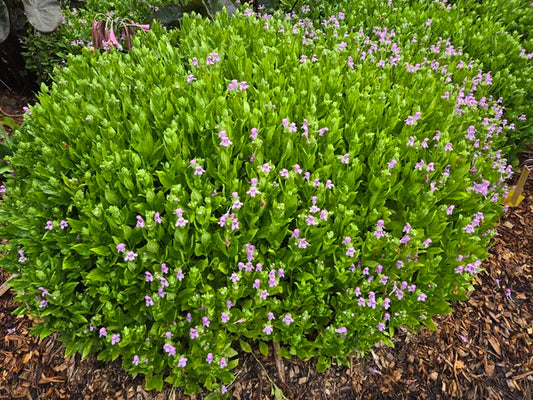
Mazus reptans has long been prized as a fabulous low growing perennial groundcover...ideal for rock gardens and between stepping stones. Expect a 1' wide patch in 3 years, topped in late spring/early summer with tiny lavender-blue flowers...simply charming! Slightly moist to average garden soils are just fine for Mazus. Pot Size: 3.5" (24 fl. oz/709.77 ml)
Meehania cordata is a delightful native to alkaline soils that naturally resides from southwest PA to the NC mountains. Meehania cordata makes a wonderful evergreen groundcover in the woodland garden with dark green cordate leaves adorning the spreading stems, which in turn are topped in late spring (late May in NC) with 5" tall spikes of blue-lavender, skullcap-like flowers. Although Meehan's wood mint prefers slightly moist soil, it is also very drought tolerant. We have seen much better flowering when meehania is grown with good morning sun. Meehania is named for the late PA botanist, Thomas Meehan. Pot Size: 3.5" (24 fl. oz/709.77 ml)
We are in love with this endangered woodland mint from the Japanese island of Honshu. We obtained this gem from arisaema expert, Guy Gusman, who found it in Japan while researching arisaemas. Meehania montis-koyae makes a spreading but non-troublesome patch to 3' wide in 5 years, which spreads by shallow rhizomes. The small, heart-shaped, olive-green leaves, highlighted by a darker green central pattern, are held along the short creeping stems. Starting in February and continuing until April, Meehania montis-koyae is topped with small clusters of tubular, mauvy-pink flowers...very attractive. Meehania montis-koyae goes comatose during extended summer heat but returns in the fall as the weather cools. Pot Size: 3.5" (24 fl. oz/709.77 ml)
Actually, we grew this clumping mint relative for the common name, but it turned out to be a rather cool plant. This native of the UK and continental Europe has fared amazingly well in our hot, humid summers. This particularly attractive compact selection from Eleonore de Koning of the Netherlands, is the nicest bastard balm we've grown...hell, it's the only bastard balm we've grown. The clump is topped in spring by stalks of small, orchid-like, white flowers, each with a dark purple lip. When not in flower, the 18" tall x 18" wide clump is composed of fuzzy green, lightly lemon-scented foliage. The question of the day is...who in their right mind would patent a bastard balm??? Pot Size: 3.5" (24 fl. oz/709.77 ml)
(aka: Dennstaedtia strigosa) The more we grow the Japanese Microlepia strigosa, the more we like it. Microlepia strigosa 'Shishi' is a compact form with congested green pinnae...something you'd only expect to order from a fancy Italian restaurant. Each 18" tall x 2' wide clump makes an attractive, lacy specimen. Above 10 degrees F, the foliage stays evergreen but below that, it is tardily deciduous. Pot Size: 3.5" (24 fl. oz/709.77 ml)
Microlepia 'MacFaddeniae' was named from the garden of California's Fay MacFadden, who got it from California's Mr. Baldwin Nursery in the 1920's. The name was first published in 1957 by Conrad Morton in the American Fern Society Journal, so it's taken quite a while to get this into the commercial trade. We planted this unique fern in 2006, and it quickly became one of our favorite hardy garden ferns. The tardily deciduous (evergreen in warmer climates) Japanese Microlepia strigosa 'MacFaddeniae' forms a slowly spreading patch to 3' wide in 5 years, composed of 2' long, narrow, arching, deeply-lobed fronds. Microlepia 'MacFaddeniae' has proven amazingly easy to grow and quite vigorous...we think you'll really like this! Pot Size: 3.5" (24 fl. oz/709.77 ml)
On a trip to the UK, the late Greg Speichert and UK grass expert Roger Grounds literally stumbled onto this variegated sport of the old cultivar Miscanthus 'Giganteus'. The result is a splendid new deer-resistant cultivar that forms a giant 10' fountain of 1" wide yellow and green striped foliage. Our 6-year-old clumps of Miscanthus 'Gilded Tower' are nearly 5' wide. The lower foliage may brown out by summer's end, so give it a nice floral skirt...better make it a kilt in case it's a male. The clumps are topped in October with typical tan miscanthus plumes, but you'll need binoculars. Location is critical if you are in an airport flight path. Pot Size: 2 qt. (1.892 L)
I first saw this stunning new miscanthus on a trip to Holland, only to find out later that it came from the folks at Joy Creek in Oregon. I have longed for a compact, heavily-banded Zebra miscanthus, and this Miscanthus 'Strictus' seedling is what I envisioned in my dreams. Miscanthus 'Gold Bar' makes a slow-growing clump, eventually to 4' tall, with rigidly upright green leaves with a very heavy horizontal yellow banding. Miscanthus 'Gold Bar' has 12-17 bands per leaf, while Miscanthus 'Strictus' has only 2-3 bands. It will take at least 5 years to reach mature size. The deer-resistant clump is topped with typical miscanthus inflorescence in late October. Pot Size: 3.5" (24 fl. oz/709.77 ml)
From Canada south to Alabama, this poor cousin of tiarella and heuchera can be found on open woodland slopes (acidic or alkaline) where the soils are fairly rich and the drainage is good. Mitella diphylla makes an easy-to-grow, 6" tall x 1' wide, heuchera-like clump of green leaves, topped in early April (NC) with 18" tall unbranched flower spikes of tiny snowflake-like white flowers. Cute...yes. Curious...yes. Showy...no. Pot Size: 3.5" (24 fl. oz/709.77 ml)
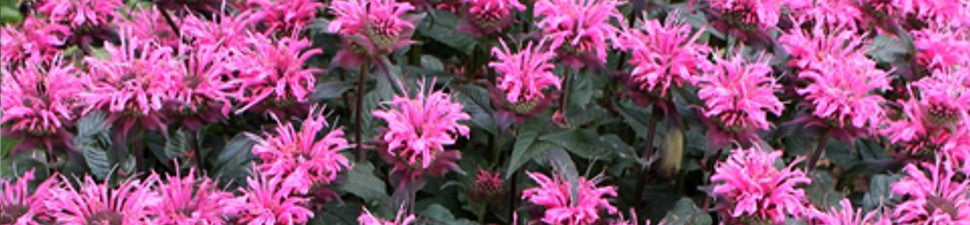
Monarda bradburiana is a central US native (Iowa south to Texas) deserving of much more widespread acclaim. First, Monarda bradburiana is a deciduous clump-former that doesn't take over the garden like many monardas. Second, it doesn't get mildew...at least not in our hot, humid climate, and third...it's the earliest monarda to flower. Monarda bradburiana makes a 18" tall x 4' wide cushion of menthol scented foliage topped, starting in early May, with terminal, light pink spotted, gaillardia-like flowers that are a magnet for butterflies and hummingbirds. Monarda bradburiana remains attractive with fascinating dried seed heads long after the flowers fade...superb! Pot Size: 3.5" (24 fl. oz/709.77 ml)