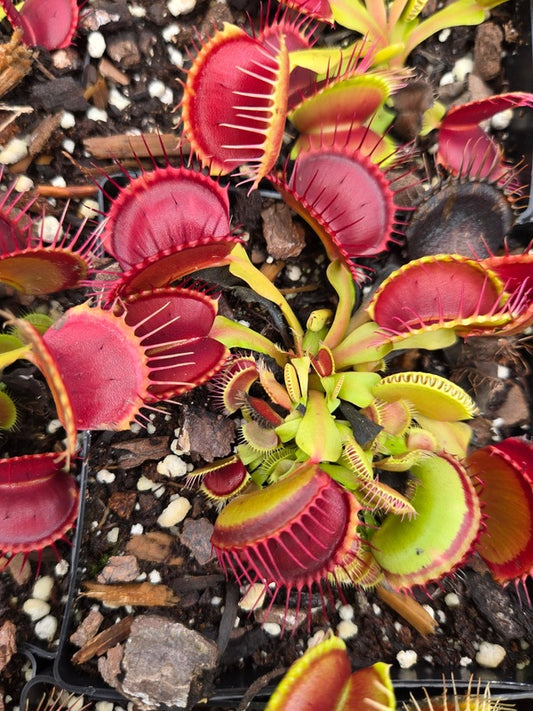

Endangered plants can be defined as those at risk of extinction throughout all or most of their range due to a sparse population or damage to or elimination of their habitat. Plant Delights Nursery knows there is no better way to conserve endangered plants than through propagation. By making ethically propagated endangered plants more widely available, we hope to increase the genetic diversity of ornamental gardens while reducing the collection pressure on native plant stands.
Read More About Endangered Plants
Plant Delights Nursery explores, identifies, evaluates and displays tens of thousands of plant varieties, including hundreds of endangered plants so we can educate anyone with an interest in gardening and nature about the threatened beauty of these rare natural gems. All of the endangered plants for sale at PDN are nursery propagated and it is for this reason we can ethically offer one of the most diverse selections of endangered plants for sale anywhere.
When you are ready to buy endangered plants for your garden, check out our online list of ethically propagated endangered plants for sale below.
Since 1988, Plant Delights Nursery has been the choice of serious gardeners and plant collectors looking for the best and rarest perennial plants. We are pleased to have received the Perennial Plant Association Retail Award in 2011, the American Horticulture Society Commercial Award in 2002, and to have been selected as one of the Best Mail Order Plant Nurseries - Garden Design Magazine 2010. Welcome to our family of plant lovers!
We had already grown Aloe aristata for several years outdoors before I was fortunate to spot it in the wild on my 2005 South African expedition at nearly 9,000' elevation. Here, it grew wedged in the rocks on a nearly sheer cliff face. In cold climates, do not plant Aloe aristata out in the open where rains can soak it during the winter months. Planting Aloe aristata near a hedge or large shrub where it can still get afternoon sun is perfect. The 9-year-old clump in our rock garden is now 6" tall x 15" wide, composed of haworthia-like rosettes of stiff green leaves. Aloe aristata clumps are topped in May with 2' tall spikes of attractive, orange, bell-like flowers. Pot Size: 3.5" (24 fl. oz/709.77 ml)
We are very excited to offer this rare but exceedingly esoteric southeast native (Global G1 rank) arabis that has graced our rock garden for several years. Arabis georgiana can behave either as a biennial or short-lived perennial with basal green rosettes that burst forth in late March with narrow stalks of small, cardamine-like, white flowers. After blooming, the entire clump goes dormant for the summer. We have found this to grow best in gravelly or otherwise loose soils where it can reseed. Despite its rarity, Arabis georgiana has proven very easy to grow. Our offering is seed-grown from a ketona dolomite glade population in Bibb County, Alabama. We hope you'll contribute to the Nature Conservancy to aid in preserving such special sites. Pot Size: 3.5" (24 fl. oz/709.77 ml)
Arisaema sikokianum is considered the most stunningly beautiful member of the aroid family and in particular, the genus Arisaema...heck...make that the entire plant kingdom! From an underground tuber in early spring (early April in NC), the dark pitcher and two five-lobed leaves emerge on a 1' tall fleshy petiole (stalk). As the pitcher opens, it reveals a swollen, pure white protruding sex organ (spadix) which provides a dramatic contrast to the purple of the pitcher (spathe). Since Arisaema sikokianum doesn't offset or engage in sexual self satisfaction, you'll need more than one to start a family. After flowering, the foliage remains attractive until it goes dormant in late summer. Arisaema sikokianum prefers a well-drained dry site in the woodland garden. Pot Size: 3.5" (24 fl. oz/709.77 ml)
We have again selected special forms of Arisaema sikokianum with dramatic silver variegated patterns in the center of their leaves. In addition to the dramatic purple-black pitcher with contrasting colors inside, you now have the additional interest of attractive leaf patterns. Arisaema sikokianum does not offset, so to have meaningful sex, you'll need at least two, although an aroid ménage à trois is much more fun. Good drainage in the woodland shade garden is essential for success. Pot Size: 3.5" (24 fl. oz/709.77 ml)
We are very pleased to offer the Federally endangered Clematis socialis, which was first discovered in 1980 and is currently known from only six sites in northeast Alabama and northwest Georgia. Clematis socialis is a rhizomatous sprawling perennial instead of a vine. Clematis socialis is incredibly easy to grow in the garden, forming a large 4-5' wide mass of wiry stems in just a few years. In the wild, Clematis socialis occurs in very moist alluvial woodland clearings, although we have found it to be extraordinarily drought tolerant in the garden. The stems are adorned with thick linear alternate leaves along with the light lavender bell-shaped flowers from April through August. Clematis socialis is an exceptional garden plant that should be more widely grown, but due to poorly thought out regulations, we can not ship these outside of North Carolina. Pot Size: 3.5" (24 fl. oz/709.77 ml)
Clematis viticaulis is another of the rare shale barren native clematis species from the Virginia mountains. The compact 15" tall x 18" wide clumps are composed of sturdy wiry stems, clothed in thick, hairy green single leaves and topped in spring with terminal urn-shaped creamy flowers with a purple blush. The most incredible feature of Clematis viticaulis is the coppery brown seed heads that replace the faded flowers and remain attractive through July (NC) when the plants may go semi-dormant. Clematis viticaulis is very similar in appearance to Clematis ochroleuca, and frankly I can't see enough difference to warrant a separate species...but that's how we keep taxonomists employed and off the streets. Our seed was shared by Virginia plantsman, Paul James, from genetics from the Aoronto shale barrens. Pot Size: 3.5" (24 fl. oz/709.77 ml)
Conradina glabra is a Federally endangered native that comes from the deep sandy soils of longleaf pine and wiregrass habitats from a small area in the Apalachicola region of the Florida Panhandle. The woody stems on this 18" tall x 18" wide sub-shrub are clothed with dark green, needle-like, highly fragrant, evergreen leaves, topped in early spring with light lavender flowers. Conradina glabra cannot be shipped outside of North Carolina. Pot Size: 3.5" (24 fl. oz/709.77 ml)
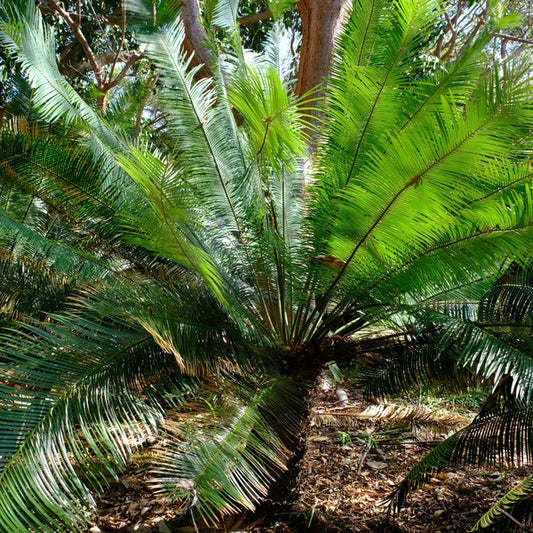
This rare cycad hails from China's southern Sichuan and northern Yunnan provinces, where it was discovered and named in 1979. Its natural habitat consists of dry, scrubby, wooded slopes where it grows in alkaline soils. Its location makes it one of the most cold hardy cycad species. In our trials so far, we have seen no leaf damage at 15 degrees F. When mature, the plant will develop a 6' tall trunk, topped with a ring of stiff "fronds", which emerge green when young but later change to glaucous. Despite reports of very rapid growth, I've seen dead snails move faster than these grow. Supplies are very limited. Pot Size: 3.5" (24 fl. oz/709.77 ml)
Cyclamen cilicium is a Turkish native that seems to prefer a bit more sun and better drainage than other species. The green and silver-mottled round leaves make a nice foil for the flowers that range in color from deep pink to white. In NC, Cyclamen cilicium flowers from early October through December...just preceding Cyclamen coum. Our clumps have thrived for more than a decade under a large eucalyptus tree...dry in the summer. Pot Size: 7.87 fl. oz (232.7 ml)
Cyclamen graecum ssp. anatolicum is a distinct form of the species from Turkey, Rhodes, and North Cyprus. The flowers appear from August through October, followed by the wonderfully patterned foliage that persists until spring. Cyclamen graecum var. anatolicum has smaller, but sweeter scented flowers than the typical species. Pot Size: 7.87 fl. oz (232.7 ml)
Cyclamen graecum ssp. candicum originates from partially sunny, but dry rocky hillsides in the Lefka Ori region of Crete, where we saw it growing in 2010. The August to October-borne flowers are white to pale pink, usually with a deep purple basal blotch. As with the species, the fall-emerging, late spring dormant leaves are incredibly patterned. Pot Size: 7.87 fl. oz (232.7 ml)
This is a rare surprise lily, imported from China in the mid-1990s by Dr. Jim Waddick. This clone is so exceptional, that we have given it the name Lycoris 'Buttermint'. The 20" flower stalks emerge from bare ground in late August, topped with large 6" flower heads of narrow, ruffled, light creamy-yellow flowers, occasionally tinged with pink as the flowers age. Our 10-year-old clumps are absolutely stunning! After the flowers finish, the bulbs produce short, strap-like basal green leaves in October. Soils that don't dry out for long periods of time in summer produce the best flowers. Pot Size: 3.5" (24 fl. oz/709.77 ml)
We saw the Cretan native, Phoenix theophrasti during our 2010 expedition to Crete...at the airport. With rumors of potential winter hardiness, we thought we'd give this a shot and since they came up so well from seed, we have some extras to share. Reportedly, the grey-green leaf Phoenix theophrasti is one of the hardiest of the feather palms....we'll find out together. Pot Size: 3.5" (24 fl. oz/709.77 ml)
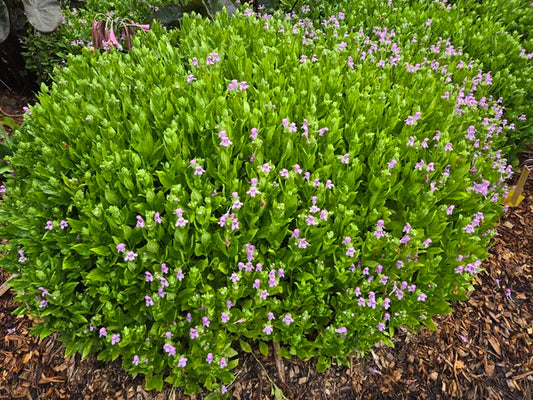
This very rare (special concern) North American native perennial is found only in a small area in southeast Texas and adjacent Louisiana. I will admit it's hard to image how an obedient plant could become endangered, but this is evidently the case. This giant species forms large colonies by way of a short, thick rhizome. The crown of Physostegia correllii gives rise to massive 7' tall, 1" thick stems, topped in early July with 12-way branched flower clusters. Each flower is a mauvy pink (RHS 77B), highlighted by dark purple speckles...quite a sight! Pot Size: 3.5" (24 fl. oz/709.77 ml)
Here's a rare US native plant that you're not likely to run into at your neighborhood garden center. Rudbeckia auriculata is endemic to a small region in southeastern Alabama and a small population in both adjacent Florida and Georgia. Our plants are cutting/seed grown from a population in Webster County Georgia. Rudbeckia auriculata grows alongside pitcher plants in moist, sunny sites, but can also be found in alkaline seeps. In the garden, Rudbeckia auriculata grows fine for us in typical garden soils where it produces 6' tall, joe pye weed-like stalks that branch toward the top. The branches are then topped with clusters of 2-3" golden orange flowers in August and September. In rich soils, Rudbeckia auriculata can lean like the Tower of Pisa, so it's best used at the back of the border, where it can find support as needed. A percentage from each plant sold goes to the Atlanta Botanic Garden for habitat preservation. Pot Size: 3.5" (24 fl. oz/709.77 ml)
This rare, Federally endangered southeast endemic pitcher plant, which is native to 2-3 counties in Alabama, was named by trillium guru, the late Fred Case of Michigan, who discovered the plant on his honeymoon in the 1940s! Sarracenia alabamensis (related to Sarracenia rubra) produces a nice, spring and fall crop of showy golden pitchers. Topping the clump in early May before the pitchers emerge are stunning red fragrant flowers on a very floriferous clump. Our original plants were purchased in 1999 under permit from sarracenia specialist Craig Moretz and these are divisions of those plants. Because of their endangered status, this is only available for nursery pickup or NC customers only. Pot Size: 3.5" (24 fl. oz/709.77 ml)
We are very excited to offer (for serious collectors only) this very rare Federally endangered NC native from high elevations in the Cumberland plateau (TN south to AL). Similar in appearance to a dwarf form of Sarracenia flava, Sarracenia oreophila occurs in sandy clay soils in mountain woodlands instead of coastal savannahs. Sarracenia oreophila grows in areas that are wet in winter with running water, only to dry completely in the summer months. The 1' tall green pitchers emerge in the early spring, followed close behind by the small yellow flowers. Sarracenia oreophila is a summer dormant species, so don't be alarmed when the leaves start disappearing. Our original plants came from sarracenia specialist, Craig Moretz in 1999. Due to their endangered status, these are available for nursery pickup or NC shipment only. Pot Size: 3.5" (24 fl. oz/709.77 ml)
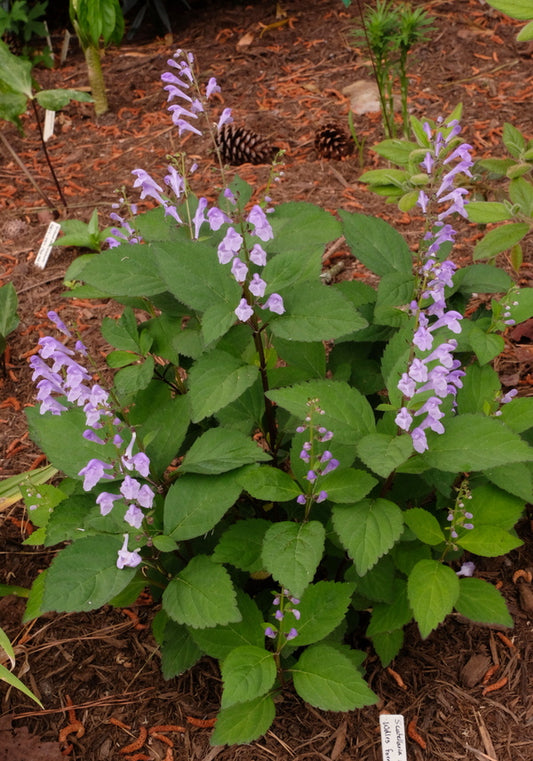
We are thrilled to be able to offer the very rare Georgia native, Scutellaria ocmulgee...not only because it's rare, but also because it's a superb garden perennial. Scutellaria ocmulgee makes a 2' tall x 3' wide clump in the garden, clothed with 3" long, fuzzy grey-green leaves. Starting in early June, the clumps are topped with large flower heads, each containing hundreds of blue flowers. Scutellaria ocmulgee is truly one of the most showy and easiest to grow skullcaps we've ever tried. Pot Size: 3.5" (24 fl. oz/709.77 ml)
(aka: Chrysoma pauciflosculosa) I'll bet you can't say Solidago pauciflosculosa three times...quickly. Here's an odd one for you...a rare Southeast native shrubby goldenrod...although some taxonomists have recently kicked it out of solidago and moved into chrysoma. Regardless, it's one odd plant that you won't find at Wal-Mart. The woody stems, clothed with thick, evergreen, linear leaves form a 3' wide clump. In early October the clumps are topped with 3' tall flower spikes of small yellow flowers. In the wild, Solidago pauciflosculosa occurs in well-drained sandy habitats. Pot Size: 3.5" (24 fl. oz/709.77 ml)
Solidago roanensis is a rare native goldenrod that can be found growing in open rocky clearings in the Appalachian mountains from Pennsylvania south to Alabama. In the garden, Solidago roanensis has proven quite easy to grow, provided the soil is well-drained. Solidago roanensis makes a tight clump of vertical stalks to 30", which open in early July as branched bottlebrush-like inflorescences of bright yellow. For us, Roan Mountain goldenrod continues flowering into October. Solidago roanensis is not a large plant like many of the other goldenrods and can therefore be easily tucked into a small spot in the perennial border. Pot Size: 3.5" (24 fl. oz/709.77 ml)