New Plants Introduced to the US Market by Plant Delights Mail Order Nursery
...including North American native plants, flowering perennials, garden ferns, perennials for shade, exotic plants, and much more.
Plant Delights Nursery is the mail order nursery division of Juniper Level Botanic Garden, a research and botanic garden facility that specializes in genetic preservation of rare plants and the development and introduction of new, rare, and unusual species and garden hybrids. Plant Delights brings to market new and exotic plants that have often never before been commercialized. Our introductions include a large array of hardy garden ferns; flowering perennials like phlox and baptisia; exotic plants like the hardy aroids, amorphophallus and arisaema; hardy garden orchids such as calanthe and bletilla; perennials for shade gardens like hosta, aspidistra, and polygonatum (solomon's seal); drought-tolerant plants including agave and yucca; tropical foliage perennials including cannas and colocasia (elephant ear); geophytes like crinum, rain lilies, and lycoris ; and native plants like trillium and hibiscus (mallows). Whether they are flowering perennials, garden ferns, or perennials for shade, we find them, trial them, and then release the rarest and the best to you. If you're looking to buy native plants or exotic plants, Plant Delights has something for you. Below is a list of some of our releases.
list updated January 2013 (N) - Named by Plant Delights Nursery (PDN) - Our Own Introductions
Abutilon Abutilon 'Marion Stewart' (D. Dulling 1992)
This delightfully saucy acanthus has paraded in the trade for years as Acanthus spinosus, but is nothing like that species...i.e., it's missing the spines. It appears perfectly intermediate between Acanthus hungaricus and Acanthus spinosus and is probably a hybrid, hence we have assigned a cultivar name commemorating its widespread culture in Holland under the wrong name. The 1' tall x 2' wide mass of deeply incised, black-green, deer-resistant leaves makes a wonderful clump topped in late spring with 2' tall spikes of white flowers hidden by spiny purple hoods. Sunny, slightly acid to alkaline conditions are best and be aware that unlike vasectomies, cutting the translocation system (roots) causes more babies. Pot Size: 3.5" (24 fl. oz/709.77 ml)
In 2011, while Israeli nurseryman Moti Kopilovitch was visiting and discussing our acanthus selections, I explained that most Acanthus mollis we tried did not survive our hot, humid summers. Moti was kind enough to share seed of a form that thrives in Israel's hot, zone 10-11 climate and we are thrilled to share the plants with you. We planted several of this Acanthus mollis in the ground to watch, so we'll all grow them for the first time together. Acanthus mollis makes a 2' tall x 3' wide clump of broad, glossy-green, deeply indented leaves that goes into a midsummer lull but kicks into high gear with the return of cooler nights. The clumps are topped with 4' tall spikes of spiny purple and white flowers. Acanthus is propagated from root cuttings, so if you dig around a mature acanthus, you will create cuttings. Pot Size: 3.5" (24 fl. oz/709.77 ml)
(aka A1FL-113) This selection of the worldwide native Adiantum capillus-veneris comes from Washington Co., Florida, about an hour west of Tallahassee. Adiantum capillus-veneris 'Falling Waters' has made a splendid patch in our garden with frond pinnae (fern leaflets) that are slightly smaller and narrower than what we typically see in other regional southern maidenhair fern forms. Our five-year-old clumps have spread to 2' wide and so far have survived single digit temperatures with no problems. Pot Size: 3.5" (24 fl. oz/709.77 ml)
(aka: Adiantum capillus-veneris A3T-022) We discovered this wonderfully cut leaf form of the southeastern native Adiantum capillus-veneris along Wasp Creek in Kendall County, Texas. Unlike most forms of southern maidenhair fern, the pinnae are shaped like narrow Japanese hand fans. For us, Adiantum 'Fan Dance' forms a tight 6" tall patch that expands to 2' wide in 5 years. We are pleased to finally be able to share this special form of southern maidenhair fern. Moist soils are best. Pot Size: 3.5" (24 fl. oz/709.77 ml)
(aka: Adiantum c-v A1CR-090) In 2010, we discovered a small patch of Adiantum capillus-veneris growing in a wet seep at 1680' elevation on the south slope of Crete's Mt. Ida...very near an amazing population of white-flowered Dracunculus vulgaris. Our spore collections germinated well enough that we are able to share. The parent clump was more compact than most of the US native forms, maturing around 6" tall. We expect a 2' wide patch in 5 years...we'll find out together. Pot Size: 3.5" (24 fl. oz/709.77 ml)
(coll. #A1HA-016) Rosy maidenhair fern is commonly grown as a houseplant but few gardeners realize its winter hardiness. Regular Adiantum hispidulum is easy to grow and reliable in warmer parts of Zone 8, but this rare form has been fine in our Zone 7b woodland garden since 2004. Adiantum hispidulum 'Mt Haleakala' makes an attractive 1' tall x 1' wide clump with fronds which emerge rosy red...hence, the common name. Our spores came from 5,000' near the top of Maui's famed Mt. Haleakala. Pot Size: 3.5" (24 fl. oz/709.77 ml)
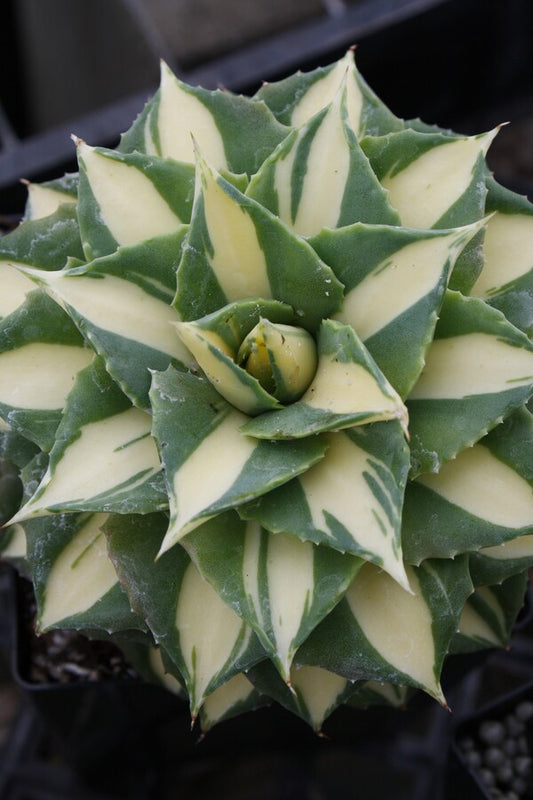
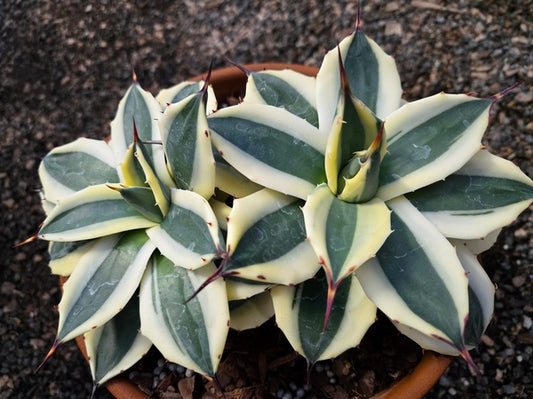
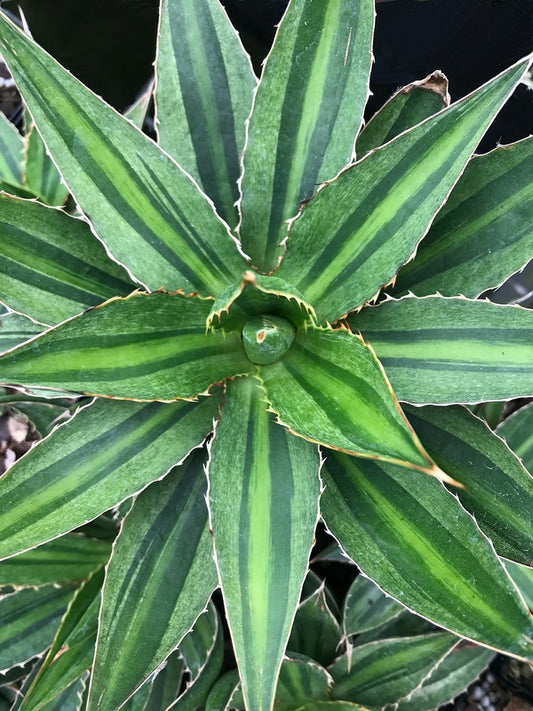
Available 6-6-2013Agave 'Desert Diamond' is the latest Hans Hansen introduction...a wide edged sport of Agave 'Kissho Kan'. Compared to its parent, Agave 'Desert Diamond' is slightly slower growing due to the extra white in the leaf, but will eventually make a 15" tall x 18" wide, sparsely offsetting variegated rosette. Agave 'Desert Diamond' is a stunning plant, especially in a container for the summer patio. Pot Size: 3.5" (24 fl. oz/709.77 ml)
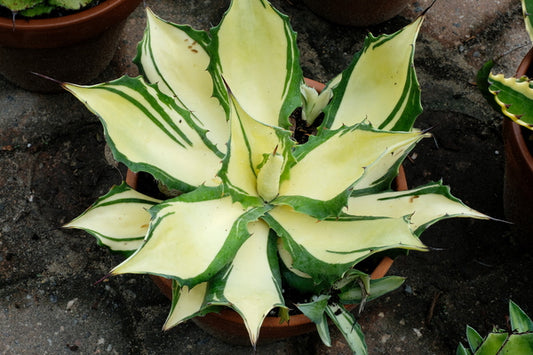
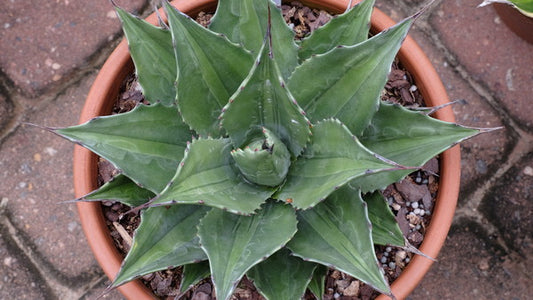
(syn: Agave guiengola 'Marginata') We are pleased to make available this elegant collector plant, whose parent originated in the Guiengola limestone cliffs of Oaxaca (pronounced "Wahaka"), Mexico. Since the name 'Marginata' has been invalid on plants named after 1959, we chose a new name, Agave 'Creme Brulee'. This soft-leaf agave is simply elegant with wide, medium green leaves surrounded by a 1" border of creamy white. While Agave guiengola can reach 3' tall x 4' wide, the variegation should slow it down considerably...we're guessing about 25 percent. Agave 'Creme Brulee' was discovered by California agave specialist, Kelly Griffin. Agave flowers attract hummingbirds. Pot Size: 3.5" (24 fl. oz/709.77 ml)
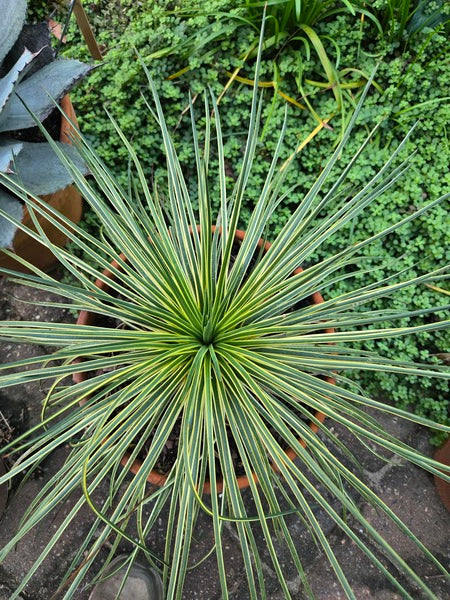
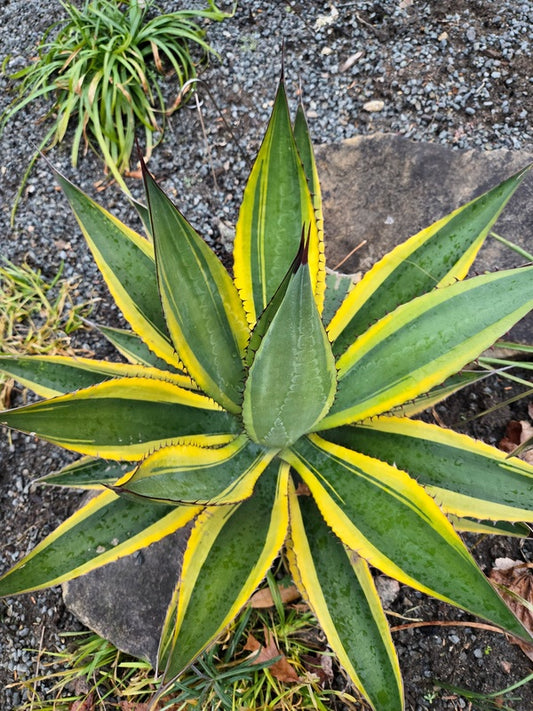
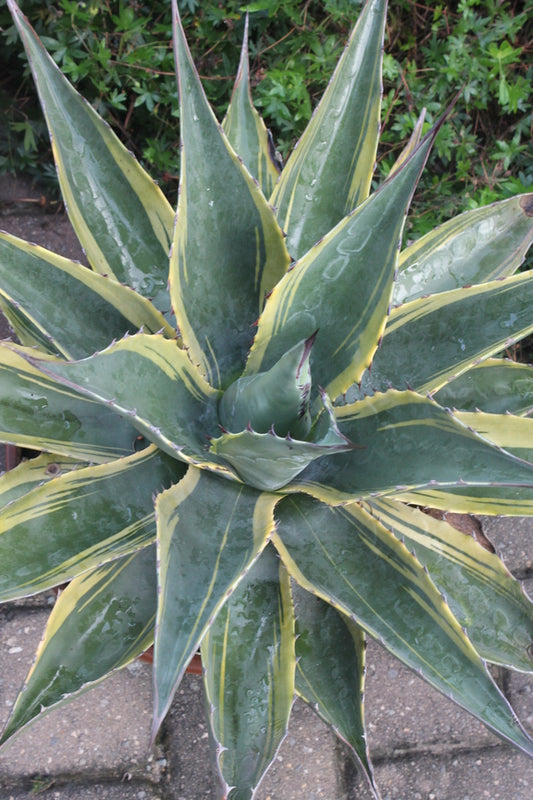
We first got this stunning selection of Agave salmiana from Marsha McPhetters's California garden, where it made a 3' tall x 4' wide clump. The upright growing rosette of concave, glossy, dark green leaves is dramatically highlighted by a creamy yellow margin. Thanks to Brian Kemble of the Ruth Bancroft Garden for assisting with naming this agave. Agave flowers attract hummingbirds. Pot Size: 3.5" (24 fl. oz/709.77 ml)
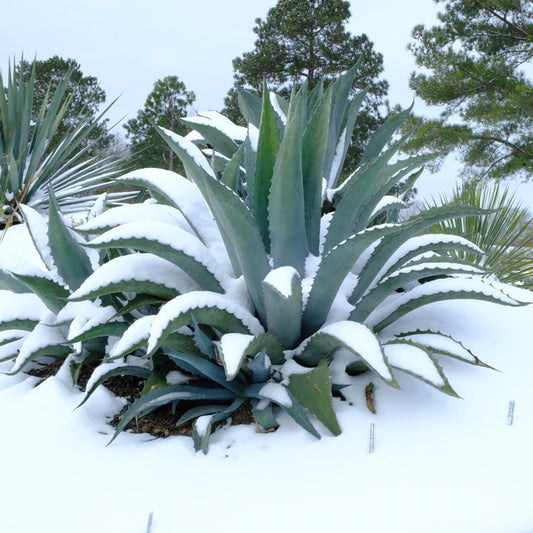
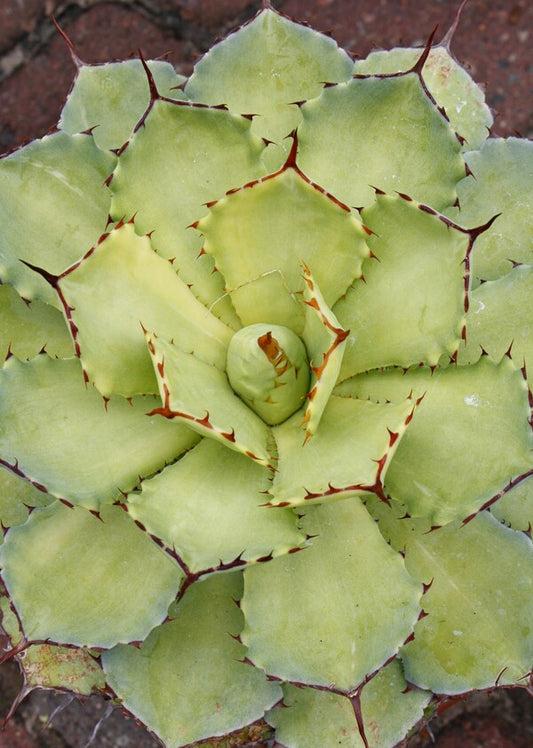
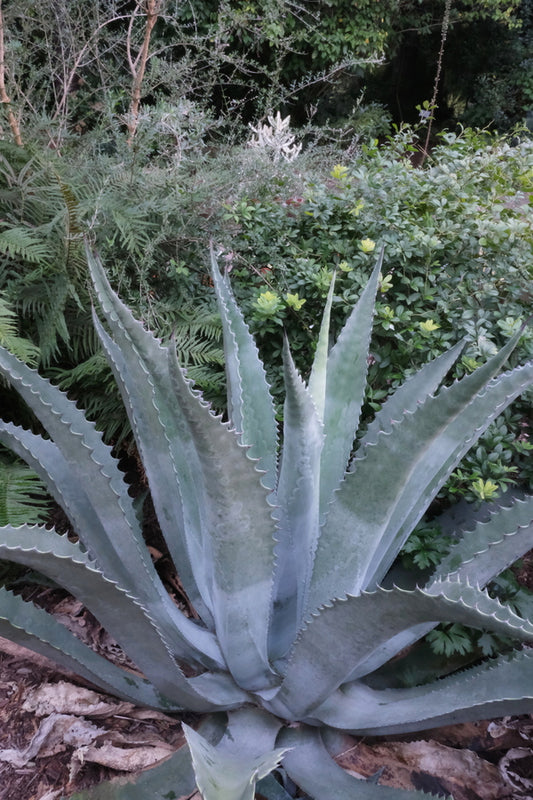
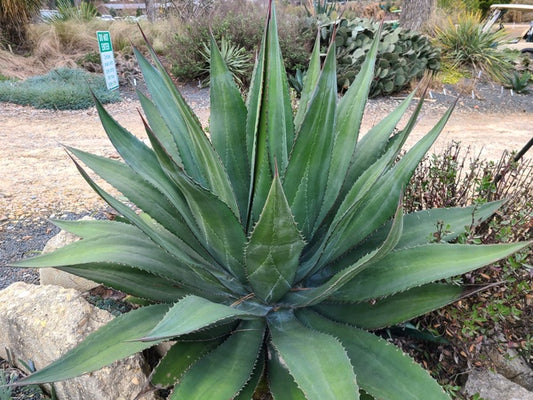
Available 6-6-2013From a 1992 Yucca Do seed collecting expedition (YD 45-83) at 5,200' in Palmillo, Tamaulipas, Mexico, where Agave americana ssp. protoamericana intergrades with Agave scabra, we selected this particularly nice clone. Agave 'Silver Surfer' has since formed a 5' tall x 9' wide clump of stiff, outfacing, silvery-blue leaves. This slow-offsetting agave is a favorite of garden visitors, so we are thrilled to finally be able to list it in our catalog...get them while they last. The 20' flower stalk is amazing, not only for the terminal clusters of bright yellow, hummingbird-attracting flowers, but also for the amazing surfboard-like flower stalk bracts. Pot Size: 3.5" (24 fl. oz/709.77 ml)
This seed collection of the dwarf Agave toumeyana ssp. bella hails from Gila County (north of Phoenix), Arizona at 4,100' elevation, where it covers the faces of large rocky cliffs, growing alongside Agave chrysantha. The cute, small, offsetting 6" tall x 10" wide rosettes are composed of narrow dark green leaves, highlighted with random straight white lines that look like someone's been snorting coke from the foliage. This form of Agave toumeyana ssp. bella has performed very well in our cold damp winters provided it is planted at an angle and has good drainage. Agave toumeyana ssp. bella is eventually topped with short 4' tall spikes of small flowers...a hummingbird favorite. Pot Size: 3.5" (24 fl. oz/709.77 ml)
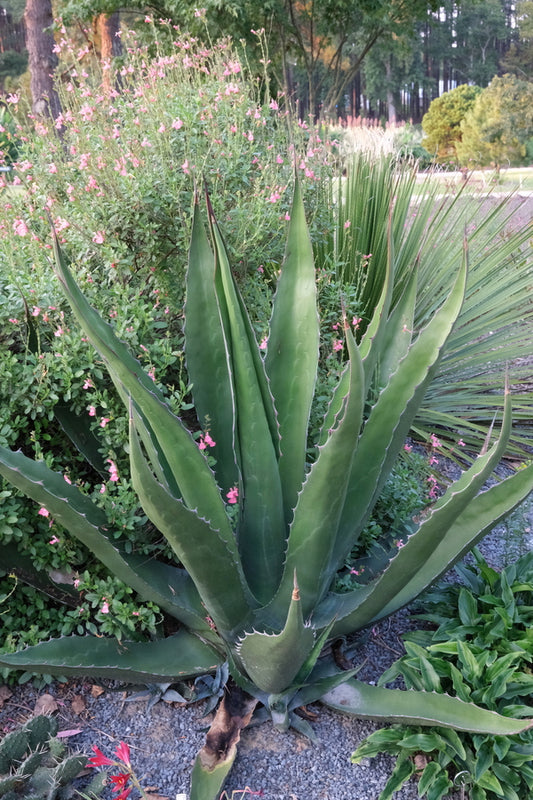
Agave 'Arizona Star' is a PDN introduction, propagated from a plant we discovered in a block of the central Mexican Agave weberi at Arizona's Mountain States Wholesale Nursery. We'd like to thank them for allowing us to make this find available. Agave weberi 'Arizona Star' makes a large, 4' tall x 7' wide specimen of 5" wide blue-green leaves, each surrounded by a 1.5" wide yellow border. The leaves have only tiny, barely visible spines along the leaf edge and one real spine at the leaf tip. This plant is not the same as Agave weberi 'Marginata', which for us has been much slower growing with cream-colored margins. Agave flowers attract hummingbirds. Pot Size: 3.5" (24 fl. oz/709.77 ml)
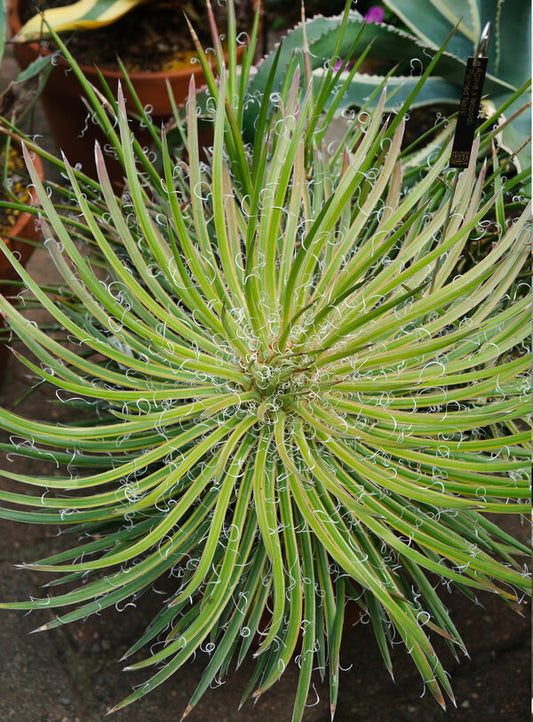
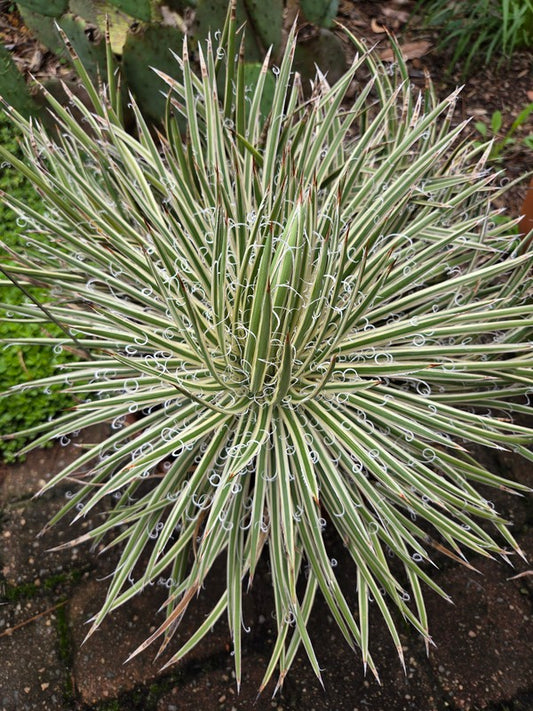
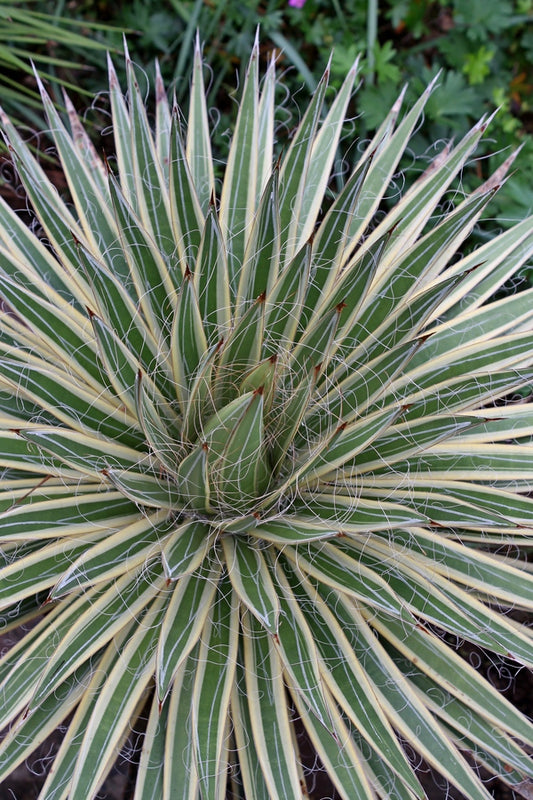
I first saw this agave when visiting the late Gary Hammer's California nursery...a plant Gary discovered in Mexico, which became variegated upon his return home. This deliciously wicked little agave is a selection of Agave x leopoldii (Agave filifera v. filifera x Agave filifera v. schidigera) that forms an 8" tall x 15" wide clump of 0.25" wide bayonet-like, dark green leaves, each etched in white, edged with a chartreuse border, then covered in curly white hairs that would make Santa proud. Agave 'Hammer Time' does offset occasionally, unlike both of its parents. Growing this gem is a bit like having a pet porcupine, so handle with care. We named this in memory of Gary, who was killed in an auto accident in 2011 at age 57. Pot Size: 3.5" (24 fl. oz/709.77 ml)
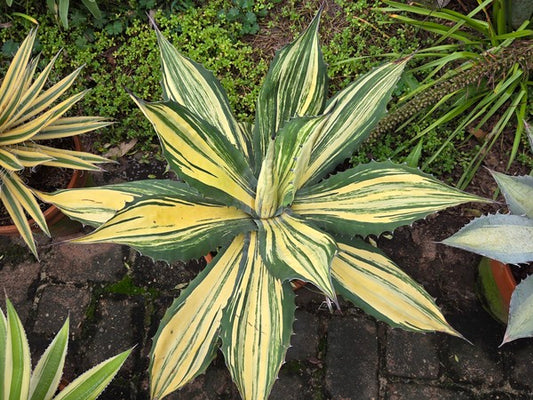
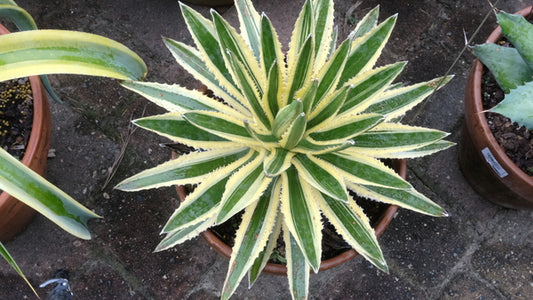
This non-offsetting gem is one of the rarest and most beautiful agaves in our collection. Finally, we have enough of this exotic variegated beauty to share. This 30" wide selection of Agave xylonacantha (xylonacantha means "wood teeth/spines") is composed of 18" long x 1" wide leaves which form a symmetrical clump. Each leaf has a medium green central stripe, bordered by a wide creamy yellow edge that ages to white. The unusual snaggle-tooth spine pattern on the leaf edge is truly fascinating. If you live in a state with gun bans, keep a leaf from this baby by the bed for protection. We're on the northern borderline for growing this species outdoors, so from here north, enjoy yours as a container plant. Eventually the fragrant agave flowers will attract hummingbirds to your patio. Pot Size: 3.5" (24 fl. oz/709.77 ml)
This stunning Allium nutans hybrid comes from the Onion Man, Mark McDonough. Allium 'Millennium' represents several generations of breeding (onions) and is head and shoulders above any other alliums we grow. The compact 1' tall x 1' wide clump of narrow, glossy green, deer-resistant leaves is topped for over a month in late summer with 2" rosy-purple flower heads. We grow Allium 'Millennium' in several locations and have never seen any sign of a stray seedling...garliccimo! Pot Size: 3.5" (24 fl. oz/709.77 ml)
We had almost given up on alliums after growing far too many weedy species but have been delighted to find great non-weedy hybrids like Allium 'Sugar Melt', thanks to Allium guru, Mark McDonough. This hybrid of Mark's combines the best traits of both Allium nutans with the popular Allium senescens. Allium 'Sugar Melt' has been a standout in our rock garden, making a 6" tall x 8" wide circular clump of narrow, green, deer-resistant leaves, topped in early July (later in colder climates) with 16" stems of light pink flower balls...a perfect rock garden plant. Pot Size: 3.5" (24 fl. oz/709.77 ml)
In 2005, we were botanizing north of Hanoi and after finding our road washed out, we retreated through a series of uninteresting back roads until sighting this bizarre form of the common Alocasia macrorrhizos in the front yard of a small home. The owner gladly shared a piece that we subsequently named Alocasia 'Shock Treatment'. This mutation of Alocasia macrorrhizos is a 3' tall clumper with glossy green, bizarrely twisted and crinkled leaves resembling a larger version of Alocasia cucullata 'Crinkles'. So far, this has proven as winter hardy as regular Alocasia macrorrhizos. Pot Size: 3.5" (24 fl. oz/709.77 ml)
(aka: Amorphophallus albispathus AGA-1017) We are pleased to offer our best silvery glaucous leaf form of Amorphophallus albispathus that we've christened Amorphophallus 'Hi Ho Silver'. This south to central Thailand species typically has green foliage, but there are a few populations where the foliage tends toward silvery blue. The unspotted flesh colored petioles that support the leaves top out at 18" tall when mature and the snow cone-like flowers are held atop 18" flower stalks in spring. When dormant, the tubers can be stored dry or left in the container sans water. This form of Amorphophallus albispathus is found in the salt spray prone limestone cliffs of Phang-Nga Bay, Thailand. Pot Size: 3.5" (24 fl. oz/709.77 ml)
Amorphophallus ankarana hails from Madagascar, where it forms a 2' tall, dark purple splotched stalk. The inflorescence is a white cup with a long pointed tip, adorned with a long purple spadix. Amorphophallus ankarana 'Fine Wine' is a 2013 Plant Delights Nursery introduction. Pot Size: 3.5" (24 fl. oz/709.77 ml)
Amorphophallus arcuspadix is a new (2012) species of Amorphophallus from an Alan Galloway discovery in Bolikhamxay Province, Laos, where it was growing in shaded areas among limestone boulders. Amorphophallus arcuspadix is closely related to Amorphophallus verticillatus. The 1' tall stalks, which are topped with typical amorphophallus foliage, multiply by stoloniferous offsets to form a small colony of stalks. The stalks of white inflorescences strongly resemble Amorphophallus verticillatus, except for the strongly arched spadix. Pot Size: 3.5" (24 fl. oz/709.77 ml)